Latest
The day's market news, with the argument attached
New notes every trading day on earnings, policy and market structure. Each one opens with the conclusion, then the evidence, then the companies it hits.
2026-10-09


44 EU Industry Groups Just Signed the Trigger Letter — Why US Steel, Chemicals and Defense Are About to Sit in the Same Risk Channel
Forty-four European industry associations urged the EU on Oct. 8 to activate every trade-defence tool available against Chinese overcapacity, ahead of an October 15–16 leaders' summit where France and Germany are pressing for a US-Section-301-style rapid-response instrument. The move mirrors the 2018 US pattern — industry filings into Washington preceded a binding 25% Section 232 steel tariff — and turns Europe's rhetorical defence into a credible binding threat. Combined with US Section 232 derivatives at 50% on 407 product categories, this pulls Nucor, Cleveland-Cliffs, Steel Dynamics, Dow Inc, LyondellBasell, General Dynamics and Lockheed Martin into a coordinated Transatlantic defensive wave that props up US margins and lifts defense demand.

Firmus Just Killed Its A$5.5B IPO. The AI Data-Center Class Just Lost Its Public-Market Free Pass.
Firmus pulled what would have been Australia's biggest IPO in three decades after investors refused to underwrite an A$30.6B valuation for a company with a forecast $77M loss and no revenue. The move is the first hard 'no' in the 2026 AI-infra IPO class and resets the price public investors will pay for AI capacity builders — a bar Nvidia clears as chip supplier, but CoreWeave, Nscale, [Lambda], and [Crusoe] are about to be tested against.
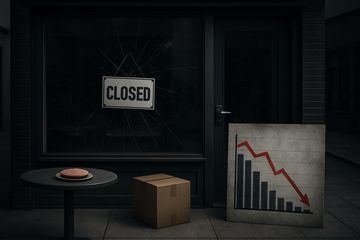
Crumbl's 57-Store Meltdown Marks the Moment the 2026 Franchise Stress Wave Stopped Being a Beef Story
A Crumbl Cookies operator in Kentucky filed Chapter 7 on October 1 with $352,780 in liabilities and just $128,143 in year-to-date revenue, the first major dessert-category franchisee to collapse in 2026 after Wendy's franchisee Meritage Hospitality filed Chapter 11 in September. With Crumbl foot traffic down 32% year-over-year, system AUV off 15.8% in 2025, and a failed dirty-soda launch that CEO Jason McGowan called the 'worst week in company history,' the stress is now bleeding from beef-priced staples into discretionary indulgences — and reshaping the royalty-stream math at Restaurant Brands International and Domino's Pizza, plus the open-air mall economics at Kimco, Federal Realty and Brixmor.

119 Lawmakers Just Told Google to Keep Its Hands Off Spirit's Worker Files — and the Real Story Is the New Rulebook for AI Training Data
On October 8, 2026, a bipartisan group of 119 US lawmakers led by Rep. Steven Horsford and Sen. Elizabeth Warren wrote to Sundar Pichai demanding employee records be stripped from Alphabet's $10 million bankruptcy-court purchase of Spirit Aviation Holdings's internal archive. The bid — roughly 100 million emails, 500 million Microsoft Teams messages, and 30 million lines of code — was meant to feed Alphabet's frontier AI, but the letter is now forcing the Southern District of New York to define, for the first time, what a bankruptcy court owes the workers of a defunct company when their data becomes frontier-lab training fuel. With a hearing set for October 14, the precedent cuts across every Ch. 11 estate with a usable corporate corpus and every AI lab racing to buy one.
TikTok Just Banned Meta's Settlement Ads — And Lit a $5.3B Fuse Under the Teen Ad Budget
Meta's $18 billion teen-safety settlement hard-caps Facebook and Instagram at two hours a day for under-18s and triggers a separate ~$10B Q3 legal charge on the Oct. 28 earnings print. With $5.3B of the payout contingent on TikTok and YouTube adopting matching rules, TikTok's first response was to reject Meta's settlement-promoting ads on its own platform as \"political content\" — a move that re-prices who owns the teen ad budget across Meta Platforms, Alphabet, Snap, Pinterest, Reddit, The Trade Desk and Magnite.
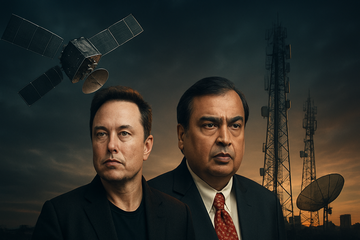
Musk's 'Real Boss' Attack Reopens a $40B Satellite-vs-Telco Fight — Why India Now Sits at the Center of Every Starlink Bid
On October 7, 2026, Elon Musk publicly named Mukesh Ambani the 'real boss of India' after accusing unnamed oligarchs of blocking Starlink's five-year regulatory slog. The Ministry of Communications fired back within 24 hours, confirming all three licensed satcom operators — Starlink, Eutelsat OneWeb, Jio Satcom — sit at the same security-clearance bottleneck. With Reliance Jio and Bharti Airtel controlling 75% of Indian wireless subscribers and signing every gateway Starlink reaches, the episode reopens a $40B satellite-vs-telco distribution fight anchored on the FCC-approved EchoStar spectrum sale, SpaceX's $11.4B FY2025 revenue base, and a $286M-to-$2.5B Indian satellite-internet TAM through 2033. The listed proxies — AST SpaceMobile, EchoStar, Viasat, Iridium, Globalstar — each carry a different exposure to the same binary outcome.
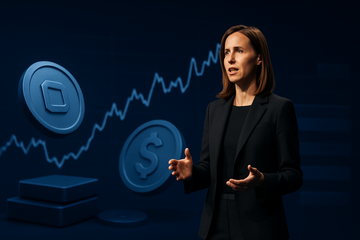
Nasdaq's CEO Made RWA a TradFi Endorsement Out Loud — Three Trades for What Comes Next
Onstage at TOKEN2049 Singapore on Oct. 8, Nasdaq CEO Adena Friedman said tokenizing Treasuries, equities and money-market funds could free \"tens of billions\" of dollars in collateral — the first exchange-operator to frame RWA at that scale. The thesis splits cleanly: Nasdaq and Intercontinental Exchange own the rails if the story holds, Coinbase and Robinhood already have on-chain volume and regulatory carve-outs, and Galaxy Digital plus Figure Technology sit in the issuance trenches that turn the unlock into fees. None of the positions are cheap, but each is exposed to a different piece of the trade.

OpenAI’s $20B Revenue Gap Is a Reporting Dispute, Not a Demand Collapse
[OpenAI] told investors annualized revenue approached $50B at the end of September, versus earlier reports of $68B–$70B; the earlier comparison included partner-gross revenue that the OpenAI measure did not. Nvidia, Oracle and CoreWeave fell 3%, nearly 6% and nearly 8% on October 8, but the market traded a reporting-basis mismatch as lost demand. The real issue is funding credibility: $50B still represents a 14.6x run-rate valuation at the confirmed $730B pre-money valuation and 28x at the reported $1.4T bridge target.

Rapid Yield Moves Have Preceded Every Major Blowup Since 1970 — and Q3 Just Delivered 87 Basis Points in 90 Days
Treasury yields are rising at the fastest pace since 1994, the 10-year touched a 24-year high above 5.35% this week, and the MOVE index has pushed through 100 — the threshold that historically marks the moment something breaks. Stocks are refusing to fall, which is itself the danger signal: every prior blowup since 1970 was preceded by rapid yields plus an eventual equity re-pricing. Bessent's \"I am the house\" trade has already been called. The question now is which asset class absorbs the next leg.

RTX's $6.3B SM-3 Win Caps a $74B Missile Backlog Wave — And the Real Pricing Power Now Lives With the Sub-Tier Bottlenecks
On October 8, 2026, RTX added a $6.3B Standard Missile-3 Block IB contract to $67.9B of multi-year missile awards already booked since August. Backlog is now binding capacity at the primes, not the limiting factor for them — the constraint has migrated to sub-tier suppliers of solid rocket motors, seekers, electronics, and energetics. That makes the underpriced trade the bottleneck suppliers L3Harris, Honeywell Aerospace, Kratos, and Mercury Systems collect rent from, while primes convert record backlogs into pricing-led margin upside.

Southwest Airlines’s 787 Dream Faces Boeing’s 1,095-Jet Queue—and a $3.5B Capex Test
Reuters reported on Oct. 8 that Southwest Airlines is leaning toward the 787 for long-haul international flying and has contemplated dozens, but no fleet decision, variant, route or financing package has been announced. An illustrative two-to-four-dozen fleet would equal only 2.2%-4.4% of Boeing’s 1,095 undelivered 787s, making the aircraft order a modest addition to an already crowded queue. The larger constraint is Southwest’s operating model: adding widebodies would disrupt a single-type fleet while the carrier is spending $3.0 billion-$3.5 billion on its 737 renewal. International growth should therefore remain partner-led near term, with owned long-haul service serving as a longer-duration strategic option rather than an immediate earnings reset.
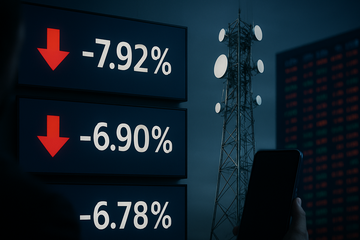
T-Mobile's Old 800 MHz Just Became Starlink Mobile's Coverage Layer — And the Carriers Priced In the Damage
Less than 60 days after T-Mobile US sold its nationwide 800 MHz spectrum to Grain Management for $2.9B, SpaceX agreed to acquire that same portfolio — completing the low-band coverage layer Starlink Mobile needed to function as a fourth US wireless carrier. AT&T, Verizon and T-Mobile US each dropped 6–7% in Thursday's after-hours trade despite the FCC having already blessed $40B of EchoStar-to-SpaceX/AT&T spectrum transfers in May. The market now prices Starlink Mobile as a structural threat to carrier ARPU, not a feature add-on — and the FCC's October 29 vote on a new mid-band auction with direct-to-device flexibility just put a floor under the secondary market that incumbents cannot match.
Microsoft and Adobe Just Lost Their Green-Card Pipeline — and So Did the AI Frontier-Lab Hiring Math
On October 8, 2026, the U.S. Labor Department suspended Microsoft, Adobe and six IT outsourcers from the PERM program while the administration opened J-1 fraud investigations at nine universities including Harvard, Stanford and MIT. The action is not a quota on individual visas — it is a program-wide shutdown of the permanent-labor channel that turns H-1B talent into U.S.-based AI researchers and engineers. With Microsoft already certified as the country's #1 PERM filer (1,504 in nine months), Indian IT firms cutting H-1B use 40% year-over-year, and OpenAI/Anthropic filings up 215% and 490% respectively, investors should price a measurable talent-cost step-up across Microsoft, Alphabet, Meta and NVIDIA — and treat the university probe as a parallel R&D-funding risk.

USDA Says US Farm Debt Hit a Record $605 Billion. Research Suggests That's Roughly Half the Story.
USDA's September 2026 forecast pegs US farm-sector debt at a record $605.1B, but a 2024 peer-reviewed study of 4.4M equipment liens found non-traditional equipment debt ran up to four times what USDA captures — and the survey USDA relies on for that bucket now responds at a 33% rate, down from 68% in 2009. With ad hoc subsidies at a record $47.4B masking cash-flow stress, farmland values still up 5%, and 312 Chapter 12 farm bankruptcies filed in the 12 months through March 2026 (+20% YoY), the real risk is the borrowing the official tally cannot see.
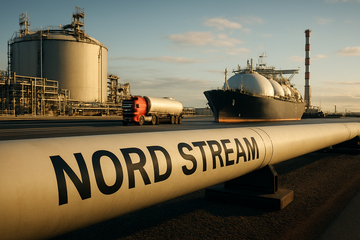
35 bcm of Russian Gas Is Being Phased Out—So the Nord Stream Headline Is Not a U.S.-LNG Shock
On Oct. 8, 2026, Reuters reported exploratory talks between Jared Kushner and Putin adviser Kirill Dmitriev about a U.S. investor in Nord Stream—not a pipeline carrying U.S.-origin LNG—and reported no agreement. The European Commission says 35 bcm of Russian gas still enters the EU annually; its adopted rules end long-term Russian LNG imports on Jan. 1, 2027 and phase out pipeline gas by Sep. 30, 2027. For Cheniere Energy, Venture Global, Sempra, and Devon Energy, the investable read is a low-probability policy option that leaves near-term cash flows intact; over 1–3 years, European diversification, not a sudden U.S.-brokered reversal, drives the LNG setup.
2026-10-08

APLD Printed 322% Revenue on a $6.4B Debt Stack — The AI Bond Wave Now Has a Live Tape
Applied Digital reported fiscal Q1 2027 revenue of $341.9M (up 322% YoY) on August-31 debt of $6.4B, with interest expense up 866% to $77.4M — the first live earnings print of a neocloud priced into 7% senior secured paper. CoreWeave, Nebius, and IREN show the cost-of-debt spread inside the AI hyperscaler/credit stack: 8.3%, 2.3%, and 1.7%. With $4T of AI debt issuance projected over five years and high-yield data center spreads blowing220 bps wider than the broad index at their peak, APLD is the canary trade — credit is the constraint, not compute.

argenx's Sjögren's Flop Erased ~$9B — And Just Rewrote the FcRn Class Math
argenx halted its Phase 3 UNITY trial of subcutaneous efgartigimod in Sjögren's disease after an IDMC concluded the study could not meet its primary endpoint, knocking ~16% off the share price on October 8, 2026 and erasing roughly $9B in market value. With Novartis's ianalumab already winning NEPTUNUS for Sjögren's and J&J's Imaavy holding a wAIHA monopoly, the premium that has paid for argenx's ~11x P/S multiple looks narrower — and the FcRn expansion story now belongs to Roche-/Janssen-/Novartis-led readouts, not argenx. The remaining Vyvgart pillars (ALKIVIA myositis win, ITP data, Empasiprubart MMN pending) keep the franchise alive but do not replace what Sjögren's TAM would have added.

Coca-Cola Tries Again to Sell Costa — at Less Than Half Price, While US Rivals Ride Out the Bean Storm
Semafor reports on October 8, 2026 that Coca-Cola is reviving its Costa Coffee divestiture, nine months after private-equity bids from TDR Capital and Bain Capital fell short of a roughly £2 billion target — about 49% below the £3.9 billion it paid Whitbread in 2018. The read-through for US coffee is sharper than the headline suggests: green-bean costs are still squeezing margins at Keurig Dr Pepper and J.M. Smucker, while Keurig Dr Pepper just closed an $18 billion purchase of JDE Peet's and Coca-Cola's own RTD-coffee push is gathering share. A Costa sale at a paper loss frees capital and concentrates Coca-Cola's portfolio on concentrates; for US rivals, a leaner Costa under PE ownership is a slow-moving, mostly UK pressure point, not an existential one.

ConnectOne's Q3 Setup Puts a $14B NJ/NY Bank in the Middle of the 2026 Consolidation Tape
ConnectOne Bancorp's Oct. 8 8-K is not a strategic action — it schedules the Q3 earnings release for Oct. 22 — but the disclosure lands a post-FLIC, $14.4 billion-asset commercial bank with a 1.0x price-to-book, 41% CRE concentration and NJ's #5 deposit share directly in front of the year's hottest community-bank M&A tape. With Columbia Financial/Northfield setting a $597M, $18B-asset New Jersey template and the industry's 2026 consolidation rate on pace for a seven-year high, the Oct. 22 print becomes the de-facto catalyst for the next move.

AI Megacaps Lost Their Grip on Oct 7. 5.36% Yields and $100 Brent Tell You Where the Money Actually Went
On Oct 7, 2026, the S&P 500 slipped 0.22% to 7,801.77 — its first close off the Oct 6 record at 7,818.95 — as hawkish Fed minutes pushed the 10-year Treasury to 5.36% intraday and Iran-fueled tanker attacks pushed Brent crude to $100.46. The cross-asset rotation is clean: the dollar (DXY 102.23) and dollar-defensives won the bid, the AI complex lost leadership, and Bitcoin sold off to ~$82,860 by Oct 8 even as spot Bitcoin ETFs absorbed $118.8M of inflows. The Q4 read is that long-duration AI capex is being repriced against long-duration yields, while short-duration dollar hedges, energy, and memory pricing are where the marginal dollar is parking — a setup that should hold until either October 27–28 Fed signals a cut or the Iran premium in oil eases.
What to expect
Evidence-first notes with a visible point of view.
This section collects sharp takes on earnings, shareholder meetings, and market structure. Each new piece should make the thesis, the facts, and the implications obvious within the first few screens.
Expect direct analysis, not generic commentary.
Expect the data to be explicit and the argument to be easy to follow.