Latest
The day's market news, with the argument attached
New notes every trading day on earnings, policy and market structure. Each one opens with the conclusion, then the evidence, then the companies it hits.
2026-10-04


2026-10-03

Apple's macOS 'Full Disk Access' Lockdown Turns the Mac Into the AI Agent Toll-Booth — Meta Muse Is Just the First Test
Apple announced on Oct 2, 2026 that it will require \"very explicit user action\" before any app can hold Full Disk Access on macOS, citing the rise of always-on AI agents — and named Meta's Muse and OpenAI's Dots as the catalysts. The move reframes macOS as the privacy chokepoint for every third-party agent running on a Mac, creating a strategic moat for Apple's Services stack while forcing Meta, OpenAI, and Microsoft to redesign the consent flows for agents that want to read users' messages, mail, and files. Investors should treat Apple's privacy stack — not its model layer — as the durable advantage in the agent era.

Airbnb's CEO just named the next platform war — and Apple's the one with the most to lose
Brian Chesky told TechCrunch AI agents need their own operating system, not a slot inside iOS. That reframes the platform fight from 'who owns the model' to 'who owns the identity, payments, and permissions agents act through' — and every major player has already staked a claim. Microsoft built the enterprise stack, Salesforce owns the CRM-native path, OpenAI is moving fastest in consumer, and Apple has the most to defend and the least time left to decide.

California's Robo-Boss Ban Just Made AI-HR Compliance a P&L Line for Workday, ADP, and HireVue
Newsom signed SB 947 on Sept. 30 — the first U.S. law forcing employers to put a human in the loop on any AI-driven firing or discipline decision. For Workday, sitting in the crosshairs of Mobley v. Workday and chasing ~$600M in AI ARR, the law turns 'AI automates your workforce' into 'AI advises a human who signs.' That compression of the AI pricing premium — plus vicarious liability already pinned on AI vendors — is the read-through missing from coverage that treats this as just another privacy bill.

Cerebras' post-IPO collapse is the first verdict on AI compute IPO economics — and Nvidia's networking stack is the judge
Cerebras Systems closed Oct 2 at $166.43, a fresh post-IPO low, after OpenAI quietly moved its GPT-6.1 Sol Ultrafast tier onto Nvidia GPUs and a 19.4M-share lockup tranche hit the tape. With ~58M more shares unlocking through Nov. 9 and NVIDIA's Spectrum-X + NVLink Fusion now defining who plugs into the AI factory, the market is repricing what a pure-play third-party accelerator is worth without Nvidia's networking. The drop is mechanical lockup pressure and structural margin pressure at the same time — and the Oct. 14, Oct. 28, and Nov. 9 unlocks will decide whether Cerebras finds a floor before its $25.4B backlog turns into the next casualty.

CME Walks Away From 24/7 Oil Trading — Kalshi Now Owns the WTI Weekend
CME Group abandoned its 10-Barrel round-the-clock crude oil contract on October 2, 2026, ending a 113-day push that the CFTC had blocked and the exchange's own customers refused to support. With the world's most liquid crude venue sidelined, the regulated US path to 24-hour WTI exposure now runs through Kalshi's pending perpetual filing — a structural shift with margin, liquidity, and competitive implications for Intercontinental Exchange, Marathon Petroleum, Valero Energy, Phillips 66, Robinhood Markets, and Coinbase Global.

Only 3% of U.S. consumers pay for AI — and the 'Super Intelligence' rebrand can't change that math
Roughly 64% of U.S. adults use AI, but only about 3% actually pay for it by a16z Consumer Edge card data through Q1 2026. Hyperscaler capex is on track for ~$800 billion in 2026, consensus $1.1 trillion in 2027, with AI capex now consuming an estimated 93% of hyperscaler cash flow. White House Executive Order 14434, signed September 29, 2026, renames 'AI' to 'Super Intelligence' across federal usage but creates no new demand — and the same-day tape (Meta +3.24%, Alphabet −0.54%, NVIDIA −0.72%) showed the market read it correctly.
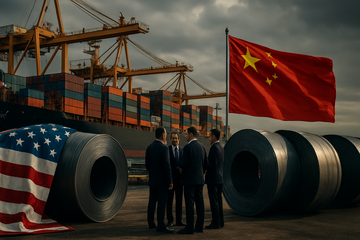
The 'Handful' of G20 Holdouts That Just Vetoed America's Industrial-Capacity Frame — and Why China's Deflation Exports Are Still Outrunning Tariffs
On Oct. 2, 2026, a 'handful' of G20 trade ministers refused to back the US push to label Chinese overcapacity a coordinated crisis, leaving Washington's tariff-led playbook without the diplomatic allies it needs to work. Apollo's 'China Shock 2.0' thesis — August Chinese exports at $401B and a $119B surplus — now has quiet diplomatic air cover, meaning the deflation wave hits US steel, autos, and solar for longer than the tariff math assumes. Investors should treat the G20 veto as a structural moat for BYD and CATL and an extended headwind for Nucor, Tesla, Cleveland-Cliffs, Ford and the tariff-protected steel trio.

The 100M-Barrel G7 Diesel Dump Ends the Refiner Trade — and Trump Pulled the Trigger
G7 leaders agreed Friday to release 100 million barrels of crude and diesel over four months — frontloading the diesel component inside 20 days — after Washington threatened a US diesel export ban. The headline number is modest (~830K bpd), but the signal is what kills 2026's best equity trade: US pure-play refiners are up 80–140% YTD on diesel cracks above $100/bbl, and the same government that let those cracks blow out just coordinated the supply that closes them. Refining margins set to compress from triple-digit records to historical norms of $30–40/bbl. The US Strategic Petroleum Reserve, meanwhile, sits at a 44-year low — meaning this is a one-shot policy tool that cannot be repeated.

Goldman's Retirement Survey Shows the Consumer Slowdown Just Became Structural
Goldman Sachs Asset Management's 2026 Retirement Survey finds the share of Americans increasing retirement contributions collapsed from 55% to 39% in one year, with 14% now cutting contributions. Combined with Vanguard's record 6% hardship-withdrawal rate and a personal savings rate under siege, the data reframes the consumer slowdown as structural: today's bills are being funded by tomorrow's accounts, shrinking the long-duration capital pool and pushing demand toward guaranteed-income annuities.

Goldman's boldest call sits in the sector Wall Street hates — 143% upside on a Rheinmetall already off 52%
When Goldman Sachs' research desk put its October 2026 'Directors' Cut' conviction list in front of clients, the loudest number on the page — 143% upside — was attached not to a hot AI name, but to Rheinmetall, the German defense prime whose stock has been crushed by 52% from its 52-week high. The same refresh added Huntington Ingalls to the US list. Together the additions say where Wall Street conviction is hiding as hyperscaler capex growth slows and AI multiples de-rate: under-owned, contract-rich European and US defense.

September Broke the Long-Short Math: Quant Funds Banked 3.5%, Discretionary Lost 0.5%
September 2026 punished the trade hedge funds were most crowded into. A Federal Reserve rate hike on Sept 16 — the first since July 2023 — combined with a Sept 14 letter from leading AI CEOs calling for a development slowdown hit both legs of the AI-long, duration-short book simultaneously. Fundamental equity long-short funds fell 0.55% on average while systematic quant funds made 3.46% — the strategy's best month of 2026 — and trend-following CTAs gained more than 4%. The dispersion between discretionary and quant was the widest in years, and the most investable signal is structural: prime brokers, trend-following platforms, and alternative asset managers captured the flow, while concentrated AI positioning bore the brunt.

Ellison Is Now Leveraged Into Both AI-Era Debt Binges at Once — and One of Them Is Already Slipping
Larry Ellison personally guaranteed $40.4 billion of [Paramount Skydance's WBD financing](psky), then watched Oracle take on $156B of total debt while pledging 413 million of his own Oracle shares as collateral. With Paramount Skydance's $52B financing package now priced — and its $44.4B bond already trading underwater — and Oracle's $18B Project Jupiter loans quoted at 89–91 cents on the dollar, the two trades now share one human balance sheet. Investors who read the Oracle and Paramount Skydance stories in isolation are missing the cross-collateralization that turns a 10% Oracle drop into a forced-sale risk on both empires.

LBMA’s gold benchmark faces a “duty of care” suit—if courts treat accreditation as liability, miners and royalties will price in a new spread
A London High Court case argues the London Bullion Market Association (LBMA) owed a legal duty of care tied to gold refining accreditation under the LBMA Good Delivery framework. The claim centers on whether LBMA’s standards and enforcement duties should have been escalated—potentially including threatening/suspending an accredited refiner—after allegations tied to Tanzania’s North Mara mine. For listed gold exposure, the risk isn’t the gold price itself; it’s how much of the physical-vs-paper “quality premium” and counterparties’ compliance costs get repriced if benchmark governance becomes litigation-sensitive.

The 'Peak Fear' Trade Is Loaded Against Itself: Vol-Control at the 98th Percentile, the 10-Year at a 24-Year High
CNBC's lead headline asks whether the panic is over. The positioning data says the opposite: vol-control funds sit at a 98th-percentile equity allocation since 2010, the 10-year yield has just hit 5.28% — a 24-year high — and the ACM term premium has re-priced above 1% even as the S&P 500 closed at 7,666 and the VIX reads just 16. The asymmetry now runs roughly 4-to-1 against equity bulls: even a mild volatility pick-up would force more than $100B of systematic selling, while upside vol-control buying is capped near $25B. This is not a market past peak fear. It is a market at peak consensus.

McKinsey's 11 million number just turned AI's labor story from Wall Street anecdote into a P&L input
McKinsey Global Institute says roughly 11 million American workers — about 7% of the labor force — may need to switch occupations by 2035, with lower-wage workers 7.6× as likely to be displaced and 85% of growing jobs requiring a credential. JPMorgan's record Q2 2026 profit paired with 30-40% headcount cuts, Atlassian's first-ever enterprise seat decline, Salesforce's shift to consumption credits, and a 17% post-earnings drop at Coursera already translate that macro figure into line items investors can underwrite.

Nike Crosses From Cost Cuts to Labor Cuts — The Tariff-Refund Turnaround Is Over
On October 1, Nike unveiled the four-year 'Pace' restructuring — a $2.5B cost program that will trigger another round of corporate headcount cuts starting in 2027 — and reported Q1 FY2027 revenue of $11.21B (down 4% reported, 5% currency-neutral), with full-year adjusted EPS guidance of $1.15-$1.35 sitting more than $0.30 below consensus. Greater China revenue fell 26% currency-neutral as Nike exits its 'Win Now' margin story and re-platforms to three geographies plus a Bengaluru campus, a sequence that, by management's own admission, requires restructuring charges and labor to offset demand erosion. The stock fell to a 13-year low of ~$33.80 — down roughly 80% from its 2021 peak — pricing in the collapse, with read-throughs already visible at Vietnam/Taiwan footwear suppliers and across the discount-tier sportswear complex.

Pennsylvania's 977 measles cases test Merck's $2.4B MMR bundle at exactly the wrong time — and expose the hollowness of Moderna's mRNA optionality
Pennsylvania crossed 977 measles cases on Oct 2, 2026 — 5 deaths, 195 hospitalizations, 39 counties — while Merck's $2.4B ProQuad-plus-M-M-R-II franchise is the only US product that can blunt it. Trump's Aug 10 executive order to split MMR into three separate doses is dead in practice: Merck and GSK say monovalent shots would take up to a decade to license, and a federal court has already stayed the ACIP votes needed to authorize the change. The outbreak sends real volume to Merck, modest pull-through to Bio-Rad, Qiagen and Abbott, and a low-eight-figure cost line to UnitedHealth, Humana, CVS Health and Elevance Health — while Moderna has no measles candidate anywhere in its pipeline and its Phase 3 CMV shot just failed.

Q3 2026: How War, $100 Oil, and a Hawkish Fed Stacked the Worst Bond Quarter Since 1994
In ninety trading days, three crises hit at once: a bond rout the worst since 1994, an Iran war that pushed Brent back above $100, and the Fed's first rate hike since 2023. ExxonMobil and Chevron reported combined Q2 net income of $26.6 billion; Lockheed Martin and RTX rode wartime contracts and a $20.7 billion Pentagon missile award; D.R. Horton, Lennar, and rate-sensitive cyclicals absorbed a 7%-plus mortgage tape. The trades that survive Q3 are the ones investors will defend when 2026 closes.

Sean Parker's Stability AI lands $76M from all three majors — turning the music-AI race into a label-owned game
Stability AI closed a $76M Series B on Aug 25, 2026, with Sony Music, Warner Music, and Universal Music as investors and training-data licensors — the first time all three majors simultaneously own a music-AI supplier. The deal comes two weeks after a Munich court ordered Suno to disclose revenue and pay damages for training on GEMA-protected music, and a week after Spotify began tagging AI-generated artist personas. With Parker's history as Napster's founder closing a twenty-year loop, Stability now sits on the only fully label-aligned music-AI platform with open-weight distribution.
What to expect
Evidence-first notes with a visible point of view.
This section collects sharp takes on earnings, shareholder meetings, and market structure. Each new piece should make the thesis, the facts, and the implications obvious within the first few screens.
Expect direct analysis, not generic commentary.
Expect the data to be explicit and the argument to be easy to follow.