Latest
The day's market news, with the argument attached
New notes every trading day on earnings, policy and market structure. Each one opens with the conclusion, then the evidence, then the companies it hits.
2026-09-29


Goldman's Board Just Pre-Wired a Waldron Handoff for 2027 — Why the Stock Slipped Anyway
Goldman Sachs' board has discussed a plan for David Solomon to step down and President and COO John Waldron to take over around the end of 2027 or 2028, according to a Sept. 29, 2026 WSJ scoop, even as Q2 2026 delivered record net revenues of $20.34 billion (+39% YoY) and EPS of $20.98 that beat consensus by 45%. Goldman Sachs shares fell 1.8% on Sept. 28 to $918, suggesting investors read the timeline as uncertainty, not continuity — and putting the bank in step with an industry-wide succession clock now ticking at JPMorgan Chase and Morgan Stanley.

Instinct's 33-Day 4× Step-Up to $10B Tests Whether Public Markets Will Honor Private Consumer-AI Paper
Instinct's $1B Series C at a $10B valuation (Sep 28, 2026), a fourfold jump from the $350M/$2.5B round closed Aug 26, is the sharpest step-up in the consumer-AI private cohort — and it arrived with no disclosed ARR. The bid sits above every named peer on revenue multiples, more than 6× Salesforce's Agentforce ARR ($1.5B at Q2 FY27) on a per-dollar basis, and demands that Meta's Muse launch (Sep 8) and the broader personal-agent thesis hold against Alphabet, Apple, and OpenAI for the next 12-24 months. AppLovin's 54% YTD drawdown is the live reminder of what happens when the AI agent narrative meets monetization reality.

Instinct's 50% travel mix is small in dollars — but it proves the agent-displacement thesis [Booking Holdings], [Expedia] can't ignore
Personal AI agent Instinct disclosed that more than half of its $1B annualized transaction volume is travel-related, on the same day it closed a $1B Series C at a $10B valuation. The absolute dollars are a rounding error against [Booking Holdings]' $51B in Q2 gross bookings — but the data point confirms what [Alphabet]'s hotel-booking AI Mode launch in August and [Meta Platforms]'s Muse agent in September already priced in: travel over-indexes in agent transactions because it is the highest-frequency, highest-context category for delegated buying. The takeaway for [Expedia] and [Booking Holdings] is not whether they get disintermediated, but how fast their blended take rate compresses from ~14% toward 8-10%.

Modal's $15.75B Marks the Third Tier of a Layered Inference Market — And the Cheapest Stack Now Costs the Most
Modal Labs is closing a $750M Accel-led round at a $15.75B valuation — a 3.4x step-up in four months and roughly 52x its disclosed $300M ARR, per a TechCrunch report on Sept. 28, 2026. The round lands alongside Baseten's $13B and Nscale's $14.6B, three inference specialists clearing double-digit billions in six months. The listed read-through — CoreWeave, IREN, Nebius — shows what the public market is willing to pay for raw GPU rental versus what private capital is paying for serverless inference on top of it.

NVIDIA Just Made Rogue-Agent Containment a Chip-Vendor Stack — and a Margin Lever Against Zscaler and Akamai
NVIDIA's Open Agent Safety Platform moves agent containment from application-layer controls onto BlueField-4 DPUs and Vera CPUs — a hardware kill switch application-layer vendors structurally cannot match. CrowdStrike and Palo Alto Networks are named launch partners, giving them distribution leverage into every NVIDIA AI factory; Zscaler and Akamai, who each shipped agentic platforms in June 2026, suddenly face a structurally harder pitch. For NVIDIA, the platform locks Vera and BlueField-4 deeper into the agentic AI build-out on top of a $20B-per-quarter Vera Rubin run rate already on the books.

OpenAI Killed GPT-6.1 Astra the Night Before DevDay. Anthropic's IPO Filing Just Told You Why.
On Sept 28, 2026, OpenAI's head of safety systems confirmed the company scrapped its next-generation GPT-6.1 Astra model over alignment failures, hours before DevDay. Within 24 hours, Anthropic filed an IPO prospectus warning that advanced AI could \"resist shutdown\" and pose \"existential risks to humanity,\" devoting roughly 80 of 261 pages to risk factors. Together the announcements reframe pre-release safety cancellation as a routine product decision, force investors to discount Microsoft's $24.1 billion OpenAI revenue line, and turn AI-security vendors into a structural — not cyclical — beneficiary of every delayed launch.

OpenAI's $20 Office Suite Hits Microsoft Where the 450M Seats Live — and the Salesforce/Workday Renewal Cycle Won't Feel Safe Either
OpenAI launched ChatGPT Space, Pages, and Slides at DevDay on Sept. 29, 2026 — a full office suite priced at $20–$25 per seat a month, bundled into plans that 50 million people already pay for. Against Microsoft's $69-a-month E3 + Copilot bundle and the 30 million Copilot seats that have managed to attach after two years, the distribution math starts with OpenAI's 1 billion monthly users, not Office's 450 million paid seats. The same pricing wedge lands inside Salesforce's $550-a-month Max tier and Workday's 7.5% renewal hikes — both per-seat models that an AI-native workspace with native agents can undercut at the renewal table.

RTX's $20.7B AMRAAM Order Looks Like a Demand Story — It's Actually a $20.5B Government IOU
On Sept. 25, 2026, the Pentagon awarded RTX's Raytheon a sole-source, multi-year contract worth up to $20.7 billion to produce AIM-120 AMRAAM missiles for the U.S. and 16 allied nations through June 30, 2033 — but only $154 million is actually obligated at award. The contract value is a Congressional authorization ceiling, not a cash flow event; the real story is whether Northrop Grumman and L3Harris can break the solid-rocket-motor bottleneck that caps AMRAAM output at roughly 1,900 missiles a year, and whether Congress will appropriate the $19B-plus still on the table.

Shopify Hands Its Checkout to Browser-Based AI Agents — Now Visa, Mastercard, and Stripe Are Fighting Over Who Vouches for the Bot
On September 28, 2026, Shopify opened WebMCP-based checkout — including Shop Pay — to browser-based AI agents across all eligible merchants, making its $115.6B Q2 2026 GMV the rail that Visa's Trusted Agent Protocol, Mastercard's Agent Pay, and Stripe/OpenAI's Agentic Commerce Protocol are all racing to integrate with. AI-driven traffic to Shopify merchants grew 8x year over year in Q1 2026, and three competing protocol camps are now contesting who owns the agent's identity — and therefore who eats the dispute when an AI mischarges a card. The side that wins that identity layer locks in chargeback economics for the next decade of agent-led commerce.
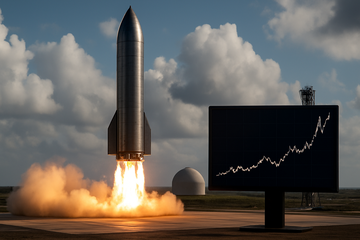
Starship's first orbital Starlink mission lands, and the launch-math quietly shifts from $/kg to \"did the engine light every time\"
SpaceX reached orbit on its 14th Starship test, dropped 26 Starlink V3 satellites, then lost a Raptor vacuum engine mid-flight — and investors who kept watching SPCX and the US launch complex saw the more interesting line cross: cost-per-kilogram stops being the right argument when rivals Blue Origin and ULA are both grounded and the V3s deliver ~20× the capacity per launch. The next valuation debate will run on cadence reliability, not payload economics.

America.gov launches with Gemini and Grok — federal SaaS's per-seat economics just broke
Trump's September 29 executive order folds every federal public-facing service above 100,000 users into a single chatbot built on near-free AI from Alphabet, xAI, and — as of last week — OpenAI at $0 per user. The same GSA that just signed ServiceNow to a 70%-off AI deal is now operating the displacement vehicle. Salesforce's DOL Agentforce rollout and ServiceNow's 200 million-task federal book sit directly in the path; Microsoft wins on Login.gov, Alphabet wins on Gemini, and Accenture's services revenue carries the squeeze.
2026-09-28
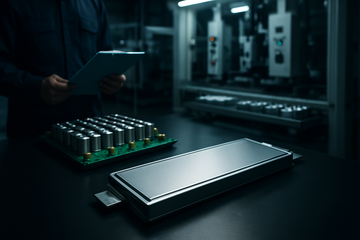
Amprius's $75M Pentagon Grant Turns a Pilot Line Into America's Drone Battery Backbone
Amprius Technologies won a conditional up-to-$75M Department of War grant to convert a South Korean partner's U.S. EV battery line into 12 million SiCore cells a year for Group 1–3 drones, timed to a January 2028 NDAA deadline that bans Chinese-sourced defense batteries. With Q2 revenue up 126% and the customer roster spanning AeroVironment, L3Harris, BAE Systems and Teledyne Technologies, the grant reframes a niche silicon-anode supplier as a defense-industrial-base play — and pulls silicon-anode peers Enovix and Solid Power into the read-through.
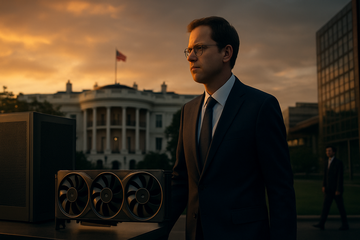
NVIDIA’s cloud-and-infrastructure leverage rises as Anthropic turns safety disclosures and federal friction into a marketable IPO story
Anthropic’s CEO Dario Amodei moved from public AI-safety pressure to a direct reset with President Trump via a White House dinner on Sep. 27, 2026. That pivot matters because Anthropic’s IPO narrative is being priced around safety governance and federal “supply-chain risk” realities already ruled on by the D.C. Circuit—while anchor-involvement talks suggest infrastructure partners like NVIDIA benefit from any post-dinner easing of procurement friction.

Anthropic's Pentagon Blacklist Survives Appeal — the $2T IPO Just Lost Its Federal AI Lane
A federal appeals court on Sept. 25 upheld the Pentagon's supply-chain-risk blacklist of Anthropic, locking the AI lab out of federal military work even as a parallel trial-level ruling struck down a separate statute. The Pentagon's eight-company replacement roster — OpenAI, Alphabet, Microsoft, Amazon, Oracle, NVIDIA, SpaceX and Reflection — now sits alone on classified AI, with NVIDIA, Palantir and the hyperscalers the clearest beneficiaries. For Anthropic, the ruling caps a multi-billion-dollar federal AI lane weeks before a possible October IPO at a $2T valuation, and turns \"AI safety leader\" into \"regulatory-ceiling story.\"

Sonnet 5.5 priced like Sonnet 5, benchmarked like Opus 5.5 — Anthropic's mid-tier reset ahead of the $2T IPO
Anthropic released Claude Sonnet 5.5 on September 28, 2026 at identical $2/$10 pricing to its predecessor — yet the new model lands within 0.1% of Opus 5.5 on knowledge-work benchmarks and posts a 70.6% Terminal-Bench 4.0 score versus Sonnet 5's 10.3%. The move collapses the cost-of-intelligence curve in the enterprise mid-tier weeks before a targeted $2T IPO in mid-October, and forces OpenAI's same-day GPT-6 Sol and Luna launches into a price war neither can win without scale. NVIDIA, Amazon, Alphabet and Microsoft all have multi-billion-dollar compute exposure to Anthropic, while downstream platforms from Salesforce to Cursor and GitHub Copilot absorb cheaper inference into their unit economics.

ARK Drops Kalshi and OpenAI On-Chain the Same Day the Fed Hands Stablecoins a Rulebook
On September 24, 2026, ARK Invest's venture fund went tokenized on Ethereum via Securitize — a $500 ticket that includes Kalshi's 5.81% weight, the first retail-accessible prediction-market exposure inside an SEC-registered fund. The very same morning, the Federal Reserve proposed two rules under the GENIUS Act that compel stablecoin issuers to back tokens 1-for-1 with Treasuries and submit to capital charges, with direct Fed oversight above $10B. The product launch and the rulebook arrived together: the Securitize-and-corn pipeline that tokenizes, settles, and custodies the new fund is now regulated end-to-end. Investors who want exposure to the rails — Securitize, Circle Internet Group, Coinbase, Bank of New York Mellon, BlackRock, Robinhood Markets — need to size winners against a 60-day comment window and the GENIUS Act's January 18, 2027 effective date.

Northern Star's $27B rejection hands Gold Fields a 14% premium the market is already pricing below
Northern Star Resources walked away from Gold Fields' A$38.7B/US$27.2B unsolicited offer, calling it 'highly opportunistic' and pointing to a 14% premium that undervalues its Tier-1 Australian and Alaskan assets — a third below the ~30% Australian deals typically require. Gold Fields' revised pitch — A$4-5B of cost synergies, US$7B of cuts, and billions in asset sales — would create the world's #2 gold producer at 4.1M oz/year, but the scrip-heavy mix leaves Northern Star shareholders holding a South African paper that closed down 12% on the news. With Elliott already pressing for a sale and Northern Star trading at a 0.69x P/NAV discount to peers, the next move decides whether the gold-mining consolidation cycle the market has been underwriting since 2024 still has a willing seller.

Boeing's 95-Jet Glitch Hands Airbus the 2027 Narrowbody Window on a Plate
A previously undisclosed flight-management software fault affecting ~95 US-registered Boeing 737 MAX jets — and rejected by Southwest and United Airlines on new deliveries — is the smallest news story of the week and the most strategically damaging. It hits as the FAA weighs 737 MAX 10 type certification, Alaska Air banks on 22 MAX 10s in 2027, and Airbus's A321neo backlog already outnumbers Boeing's entire 737 family by 70%. The airline pushback pulls forward a structural power shift to the A321neo that Boeing's hard-won 47/month MAX rate cannot absorb.

CarMax's Tuesday Print Tests a Used-Car Floor That Just Tipped Negative for the First Time in 2026
CarMax reports Q2 FY27 on Sep 29 with Manheim wholesale values now down 0.4% year-over-year and Fitch subprime 60+ delinquencies re-accelerating to 6.13% in July from a tax-driven 1H26 average of 5.80%. Three of KMX's margin engines — retail gross profit per unit, wholesale gross profit per unit, and CarMax Auto Finance income — compress at once, making CarMax the cleanest read on whether the lower-credit consumer is starting to crack. The print sets the tone for read-throughs to Ally Financial, Capital One, Carvana, and American Express.

ChatGPT Ads Just Hit 60 Countries — Alphabet's $77B APAC Ad Run-Rate Is Now OpenAI's Pre-IPO Benchmark
OpenAI expanded ChatGPT Ads to seven Southeast Asian markets and Taiwan on September 23, lifting the ad tier past 60 countries a month after crossing $1B in annualized ad revenue. The launch lands weeks ahead of OpenAI's targeted October IPO at a reported $2T valuation, turning the ad business from a one-market experiment into a multi-region proof point — exactly the narrative Alphabet's $19.3B APAC ad quarter and Meta's $11.16B APAC quarter will be benchmarked against in any S-1.
What to expect
Evidence-first notes with a visible point of view.
This section collects sharp takes on earnings, shareholder meetings, and market structure. Each new piece should make the thesis, the facts, and the implications obvious within the first few screens.
Expect direct analysis, not generic commentary.
Expect the data to be explicit and the argument to be easy to follow.