Latest
The day's market news, with the argument attached
New notes every trading day on earnings, policy and market structure. Each one opens with the conclusion, then the evidence, then the companies it hits.
2026-09-27


Five Data-Center IPOs Now Sit in One Scrutiny Bucket — and the Class, Not the Names, Is the Trade
DayOne, Switch, Vantage, CyrusOne, Accelevation and Nscale are being priced off a single set of filters: contracted power, customer concentration, and post-rate-hike hurdle rates. That filters out the marginal developers but leaves Vertiv, GE Vernova and Eaton insulated by their order books, CoreWeave and Nebius re-rated by the same lens, and Microsoft, Amazon and Alphabet decoupled because their data-center capex is already committed.
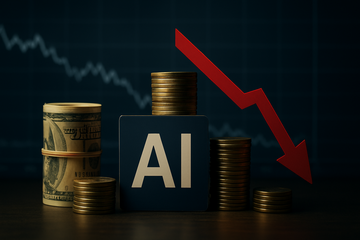
Goldman's $300 Billion Reality Check: Hyperscalers Are Spending AI Money They Haven't Earned Yet
Goldman Sachs strategist Ryan Hammond says the five largest U.S. hyperscalers need roughly $300 billion in annual AI revenue to break even on their AI capex — yet Q2 2026 cloud revenue is running only ~$70 billion above the pre-AI trend, leaving a ~$230 billion gap. With the group's free cash flow projected to turn negative through 2026-2027 and more than a third of next year's AI investment funded by debt, the AI trade splits: upstream beneficiaries like [NVIDIA], [TSMC], [SK Hynix] and [ASML] keep winning on volume, while Microsoft, Amazon, Alphabet, Meta and Oracle face a cash-conversion test that earnings season — not capex announcements — now decides.

Alphabet's Buy Button Just Landed in Flipkart — and India Becomes the Lab Where US AI Agentic Commerce Meets the Festive Cart
Google has started letting Indian shoppers tap a Buy button on Walmart-owned Flipkart listings inside Gemini and AI Mode, the first live test of agentic checkout on UCP outside the U.S. The test is narrow — smartphones, electronics and accessories — but it lands days before Flipkart's October 9 Big Billion Days sale and gives Alphabet a structural head start over Amazon's walled-garden Alexa for Shopping and OpenAI's India ad layer, because checkout, not conversation, is what moves GMV.

The Hospital AI Uplift Cost Insurers $942M in Two Years. UNH, ELV, HUM Are the First Test
On September 24, 2026, the Blue Cross Blue Shield Association quantified hospital AI's effect on payer medical-cost lines at $942M over two years — a direct counter-narrative to the productivity thesis underwriting UnitedHealth Group's $3B AI bet, Alphabet's AMIE, and the Anthropic-OpenEvidence global rollout announced two days earlier. Elevance Health's BCBS-licensed book and Humana's Medicare Advantage risk-adjustment math are the lines where the cost-tilt first shows up in the P&L. Q3 2026 earnings will either ratify the BCBSA sample or make it a one-off.
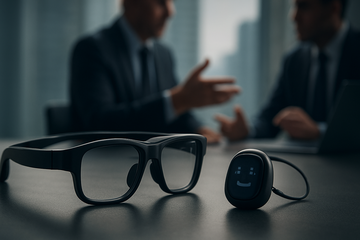
Meta Made Smart Glasses the AI Front Door — and Used a Tamagotchi to Do It
At Connect 2026, Meta Platforms launched five glasses SKUs plus a $1,299 VR headset and a 5G \"Muse Charm\" Tamagotchi — pushing smart glasses out of a niche and into the mass-market AI front door at $349–$449. The agent loop now runs through a fingerprint-tapped pendant, not a chat window, putting pressure on Apple's $3,699 Vision Pro and the still-unlaunched OpenAI/Anthropic hardware plays. Reality Labs still bled $4.62B in Q2, but smart-glasses shipments are up 167% YoY and Qualcomm plus EssilorLuxottica own the supply chain underneath.
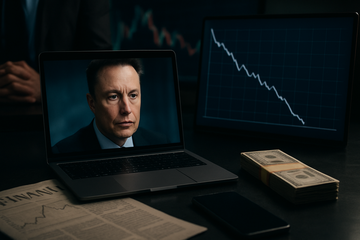
Meta and YouTube Just Called the 'Musk' Doc Ad Block an 'Error' — Algorithmic Rejections Are Now Tradeable Platform Risk
On Sept 26, 2026, Meta Platforms and Alphabet reversed their refusal to run paid trailer ads for Alex Gibney's \"Musk\" documentary, calling the original blocks 'an error' and 'a temporary system restriction' after a 48-hour backlash. The reversal reframes political-content ad suppression as a quantifiable platform-risk mechanic: the platforms that walked it back took a brand-safety hit, the holdouts (TikTok, X) signaled they can absorb it, and Snap sits outside the fight with a disclosure-based political-ad stance. For investors, the trade is the gap between ad-revenue concentration, political-ad policy posture, and reversibility risk.
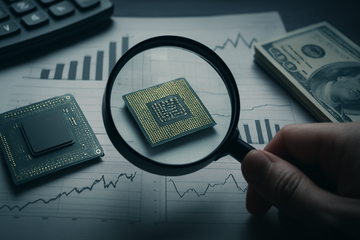
Micron's Print Has Nowhere to Hide: The Quarter That Audits the AI Memory Trade
Micron reports fiscal Q4 2026 on Sept. 30 with its own $50B revenue guide already above consensus, a stock trading near $1,082 into the print, and a Burry-led bear case arguing the SOX index is the most overextended since 2000. The data — HBM sold out through 2027, 84.9% Q3 gross margin, 16 long-term take-or-pay contracts, and SK Hynix's HBM share already slipping from 64% to 50% year-over-year — says the cycle isn't broken yet. The verdict turns on whether the print reframes the next two years of NVIDIA and Broadcom capex dependency or capitulates to the cracks Burry, UBS's slowing-capex forecast, and SK Hynix' own 'abnormally high' price warning have already opened.

OpenAI Turned Australia's Youth Safety Rules Into a Pre-IPO Product — and a $1T Compliance Moat
OpenAI's September 18 Australian Youth Safety Blueprint is not a regulator's directive — it is a self-imposed six-pillar product the company built before its confidential S-1 goes public, and it is already spreading to California, New York and the EU. As Australia finalizes a Digital Duty of Care that explicitly captures AI services, Microsoft's27% OpenAI stake and Azure-hosted ChatGPT for Teens become the only consumer AI with both a pre-built compliance spine and the regulatory relationships to shape the rules. Investors who read safety frameworks as cost are misreading the IPO: they are the disclosure scaffolding that defends a $1T valuation.
OpenAI Just Made 'Model Misalignment' a Pre-S-1 Risk Factor — and a Buying Thesis for CrowdStrike, Palo Alto Networks, and Zscaler
On Sep 16, 2026, OpenAI published a framework to publicly disclose individual model-misalignment incidents, including six specific cases from the past six months. Because OpenAI has a confidential S-1 on file since June and Anthropic has a $2T IPO targeting mid-October, that commitment instantly becomes a new risk factor both companies must mirror in their public prospectuses. The same disclosures also reset enterprise demand for runtime AI-agent security, pulling forward revenue at listed vendors already running agent-governance platforms.

OpenAI Hands ChatGPT the Ad-Buying Wallet: Sponsored Agents Force WPP, Publicis, Omnicom to Pick Between Partner and Prey
On September 16, 2026, OpenAI launched Sponsored Agents — ads that open a branded chat inside ChatGPT instead of a website — alongside a marketer toolkit inside ChatGPT Work and integrations with HubSpot and Shopify. Coming on top of a $1B ads run rate in 200 days and a confidential S-1 for an $852B–$1T IPO, the move reframes the question for brands: who is the agent of record when the agent is the platform? WPP is already down 4.7% LFL in H1 2026, while Publicis Groupe is up 4.7% organic — the four big holdcos are simultaneously OpenAI's biggest agency partners and the most exposed legacy players in a stack that just lost its front door.

Oracle's $988M of CEO Options Went Underwater on Day One — That's the Real Story
Oracle's newly promoted co-CEOs and Larry Ellison took options struck at $280 and $308.46 in late 2025 — at the very peak of the AI capex narrative. A 53% share-price collapse since turned the entire $988 million grant intrinsically worthless before a single year of vesting completed. The episode exposes a deeper truth: management's payout sensitivity has flipped from upside-aligned to upside-disconnected, even as Oracle commits to a $90 billion FY2027 capex plan funded by $125B of debt. Investors who re-trade Oracle on \"AI optimism\" are now trading on a separate curve from the people running it.
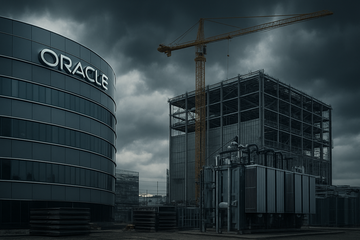
Project Jupiter’s $18 Billion Haircut Tells You Where AI Infrastructure Risk Has Quietly Migrated
Oracle’s force majeure on its $165B New Mexico AI data center is the first tenant-issued notice in a Stargate-era build — it pushes payment risk off the tenant and onto the developer Blue Owl, whose $18B project-finance loan now trades at 89–91¢, and onto equipment suppliers like Bloom Energy whose order pacing hinges on a stalled gas pipeline and a 2.45 GW microgrid running at 10% complete. The optionality Oracle is preserving, more than any demand question, is the real signal.
SpaceX's $26.5T AI TAM Is Now Doing the Heavy Lifting for a $1.77T IPO Trading Below Its Own Price
SpaceX bought xAI on Feb. 2, 2026 at a $250B implied price, then disclosed in its May 20 S-1 that $26.5T of its $28.5T total addressable market sits in AI. The June IPO priced at $135 per share, valuing the combined company at $1.77T — but the stock now trades below the asking price even after a CFO update placing the AI compute ARR run-rate at $41B. The TAM math is defensible on paper; the Q2 numbers say it has to be earned.

Meta and Microsoft Crushed the 5.18% Yield Bar — The AI Capex Cycle Is Now Its Own Equity Factor
The 10-year hit 5.18% on Sept. 24 — the highest of the cycle and a level last seen in 2007 — and Meta Platforms and Microsoft still dragged the Nasdaq up 2% on the week. The move isn't a one-day bounce; with hyperscalers running ~$700B of AI capex in 2026 and financing roughly a third of it in the bond market, AI demand has become large enough to override duration math. That resets the question for the Warsh Fed: 5% yields no longer choke risk assets when capex = revenue = EPS.
Alabama's $100M TikTok Settlement Hands Snap and YouTube the State-AG Playbook on a Silver Platter
TikTok's September 25, 2026 deal with Alabama — $100M minimum, $116.2M in restitution, up to $300M if40 other AGs settle — is modeled directly on Meta's August $18B agreement and is the first state-level settlement in the teen-harm wave. The $183M contingent pot only releases if peers settle, and Meta's deal holds a separate $5.3B payout hostage to TikTok and YouTube adopting the same teen time-caps. The economic lever now points squarely at Snap and Alphabet's YouTube — and at the structural ad-revenue hit from capping teen screen time across the industry.

A Statistical Revamp Could Vindicate the Fed's Doves — Tom Lee Says Crypto Catches the Easiest Lift
Fundstrat's Tom Lee argued on Sept. 27 that the BEA's Sept. 30 PCE methodology revision could lop 20-40 bps off core inflation, retroactively showing the Fed's Sept. 16 hike was premature — and that the resulting policy walkback is bullish for crypto, not just rate-sensitive equities. Bitcoin trades near $84,400 with spot ETF flows already flipping positive; the equity proxies that scale the move are Strategy Inc, Coinbase, MARA, Riot and Robinhood.

Brent fell 2.8% on Trump's Iran rejection — but the war premium just locked in until the midterms
Iran's seven-day Hormuz proposal and Trump's Sept 26 rejection wasn't priced as escalation. EIA still forecasts 5.7M b/d of Middle East shut-ins through Q4, and the WSJ reports Trump expects renewed bombing after the November elections. The 'no-deal' outcome is the structural bull case for US Gulf refiners (Marathon Petroleum, Valero, Phillips 66) and tanker owners (Frontline, International Seaways, DHT Holdings) even as integrated majors carry less upside.

Wall Street reclaims the wheel from retail — and the S&P's marginal buyer just changed
Institutional capital has replaced retail as the dominant force in US equity flows, per Vanda Research and Goldman Sachs data cited by CNBC on Sept 27, 2026. With the 10-year Treasury yield stuck above 5%, AI trade fatigue setting in, and corporate buybacks going dark, the market's marginal buyer is now far more rates-sensitive than the 2021-era retail-flow models assumed. The flip is already showing up in record equities trading at Goldman Sachs, JPMorgan, and Morgan Stanley, while pure-play retail platforms face the steepest comp drag.
2026-09-26
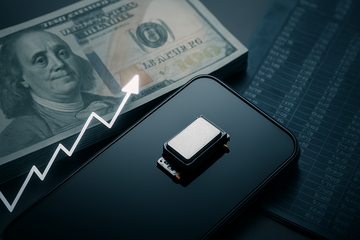
Apple's $5.7B Haptic Verdict: Why a ~$10 Vibration Motor Just Became a 4% Drag on Apple's Earnings
A San Diego federal jury ordered Apple to pay Taction Technology $5,721,961,750 on Sept. 25, 2026 — the largest U.S. patent infringement verdict ever — for haptic feedback patents reading on the Taptic Engine that powers every modern iPhone and Apple Watch. The same jury declined to call the infringement willful, removing the treble-damages threat but leaving Apple on the hook for a one-time charge roughly equal to 4.4% of trailing net income. Investors can absorb the cash hit; what they cannot absorb is the precedent that two asserted claims covering \"damped bass-frequency vibrations\" now bind Apple's installed base of more than a billion haptic-equipped devices. Upstream, AAC Technologies and GoerTek sit inside the patent's shadow; downstream, Samsung Electronics — already locked into Immersion's haptic IP since 2013 — just picked up an underpriced competitive moat.
Blackstone's Rainmaker Era Ends — But the $1.35T Franchise Already Told You What Comes Next
Joe Baratta, the face of [Blackstone]'s $450B private-equity unit, is leaving by year-end — the third senior exit this year, with a Form 4 sale seven days earlier that did the talking. The Q2 2026 numbers already reveal the post-rainmaker playbook: record $1.35T AUM, $228B of dry powder, BCP IX and BCP Asia III closed, and a Medline secondary that is testing the public-market exit window right now. For [KKR], [Apollo Global Management] and [Carlyle Group], the question isn't whether the star dealmaker is gone — it's whether their own diversified franchises can monetize the $50B+ exit queue ([Medline], [athenahealth], Mimecast) faster than [Blackstone] can.
What to expect
Evidence-first notes with a visible point of view.
This section collects sharp takes on earnings, shareholder meetings, and market structure. Each new piece should make the thesis, the facts, and the implications obvious within the first few screens.
Expect direct analysis, not generic commentary.
Expect the data to be explicit and the argument to be easy to follow.