Latest
The day's market news, with the argument attached
New notes every trading day on earnings, policy and market structure. Each one opens with the conclusion, then the evidence, then the companies it hits.
2026-09-23

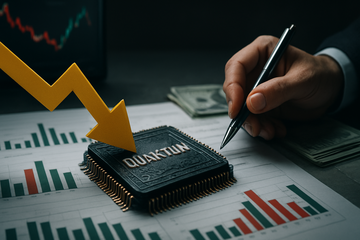
Insiders Dumped 895 Million Quantum Shares With Almost No One Buying — The Cross-Stock Warning Wall Street Can't Unbundle
Insiders across IonQ, Rigetti, D-Wave, and Quantum Computing Inc. have net sold 895.1 million shares since September 2024, with insider buying collapsing to near zero at every name — a synchronized signal no single stock can shake off. Against combined TTM revenue of roughly $282M and a combined market cap near $29B, the cross-stock symmetry shows the pure-play quantum thesis has detached from fundamentals. With D-Wave's operating loss more than doubling year-over-year and IonQ absorbing a $1.87B GAAP hit from a $1.6B warrant write-down in Q2, the cash burn is real even as the macro bid is fading.

The Pentagon Now Writes the Space Investment Tape — $23B TTM, Doubled YoY
Private space-tech investment hit $23B in the12 months to June 2026 — more than double the $9.7B TTM a year earlier, per Seraphim's tracker. The story isn't the SpaceX IPO; it's the Pentagon's Golden Dome ($185B plan), Starshield contracts, and a parallel surge in Delhi. For investors, the trade is exposure to the defense primes and dual-use launchers, not pure commercial space.
US Business Activity Just Hit a 62-Month High — and the Bond Market Is Now Pricing the Second Warsh Hike
The September S&P Global flash PMI printed 58.4 on the composite, 58.7 on services and 57.0 on manufacturing — all multi-year highs — while input prices surged to their fastest in four years. Just seven days after Kevin Warsh's Fed delivered an unanimous 25bp hike to3.75–4.00% and the median dot plot pointed to 4.1% by year-end, the10-year yield has pushed to 5.08% and OIS is back to pricing another25bp move. The trade is no longer 'when do we cut' but 'is October28 the second hike' — and the sector re-rank flows through to JPMorgan Chase, ExxonMobil, and duration victims like Realty Income.

Verizon's $70M AI Training Pledge: $50M Is New Money, $20M Is Recycled From Layoffs — And That Split Is the Whole Story
Verizon says $70 million for nationwide AI training, but only $50 million is genuinely new spend; the other $20 million was already committed in November 2025 alongside 13,000 job cuts. Strip away the repackaging and the new AI workforce commitment equals 0.04% of FY2025 revenue and 0.3% of 2026 capex guidance — symbolic, not financial. T-Mobile, AT&T, and Comcast now have a public benchmark to match or ignore, while training-content partners Coursera, Microsoft, Alphabet, and IBM inherit a captive pipeline into up to 100,000 trainees.
2026-09-22
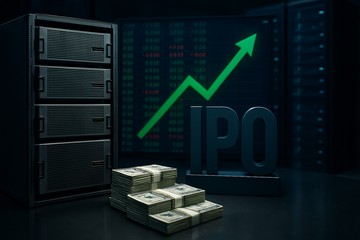
Accelevation's $5.4B IPO Tests the One AI Trade Wall Street Hasn't Priced: the Rack-Builder
Accelevation filed to price 30 million shares at $20–$24 on Sept. 22, 2026, targeting a $5.37 billion market cap — the first standalone US listing of a vertically integrated power-distribution and white-space manufacturer built specifically for AI data centers. Its $1.1 billion backlog and 32% gross margin sit between Crusoe's $30.9 billion private mark and Vertiv's $96 billion public valuation, putting the multiple for the rack layer of the AI build on the tape for the first time.

AI Bond Buyers Now Sort Issuers by Business Model — Oracle's 18-Year CDS High Marks the Crack
For two years, investment-grade buyers treated 'AI debt' as a single trade. In mid-2026 they started splitting it. Oracle's 5-year CDS printed an 18-year high of 215 bps while peers traded near 80 bps; Broadcom's CDS jumped 28 bps in August as $60-100 billion of off-balance-sheet AI chip debt came into view; Amazon's €25 billion deal cleared with only 20 bps of concession. The discrimination runs along business-model lines — diversified cash flow versus concentrated AI capex, public IG versus off-balance-sheet chip SPVs, take-or-pay lease versus GPU-secured term loans — and it has immediate consequences for IG index holders, neocloud equity, and the BDCs that hold 32% of their portfolios in software.
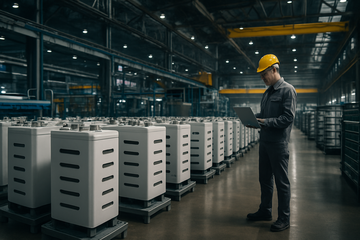
EnerVenue Just Built Its First Factory in China, Not Kentucky — and the Math Was Always Going to Win
EnerVenue, the US nickel-hydrogen battery startup that walked away from a $264M Kentucky plant after winning state incentives, opened mass production in Changzhou the week Trump sits down with Xi. The draw was graduate engineers at $1,792 a month and a local supplier base that finances itself until design wins — advantages no state subsidy can offset. For energy-storage hardware, China is now the factory of factories, and US startups with novel chemistries are voting with their capex. The investors who read this correctly will reposition around Chinese battery dominance, US industrial-policy wreckage, and the long-duration storage race.

DOJ's Iran-Sanctions Probe of Binance Makes Compliance an Earnings-Line Tax — And the Listed US Venues Aren't Priced for It
DOJ opened a formal probe (Sep 22, 2026) into whether Binance failed to stop Iran-linked trading on its platform — eight days after the same Manhattan office filed a $61M civil forfeiture tied to the same network. The 2023 plea deal already extracted $4.3B and imposed a three-year monitor; this new probe tests whether that monitor can be trusted. For Coinbase, Robinhood, and Circle, the question shifts from whether 'crypto compliance' is a marketing line to whether it now hits the income statement — and whether flow migration from Binance's 39% global spot share becomes a domestic-venue tailwind or a generic 'crypto crackdown' headwind.

DeepSeek at the UN Security Council reframes the Trump-Xi chip trade — Beijing is exporting AI rules while blocking NVIDIA's H200 at home
Chinese AI lab [DeepSeek] will brief the UN Security Council on AI risk on Sept. 23, alongside OpenAI's Sam Altman and [Anthropic], marking the first time a frontier Chinese model developer speaks inside the chamber. The briefing lands as Trump and Xi sit down again with chip export terms unresolved: Washington approved limited NVIDIA H200 sales in January, Beijing has refused to let its own cloud firms (Alibaba, Tencent, ByteDance) take delivery. That asymmetry — exporting governance while blocking US silicon — rerates the China AI compute stack into SMIC and Cambricon, and rewrites what a $2T [Anthropic] IPO is actually pricing.

DoorDash's $131.5M 'We Screwed Up' Settlement — and What It Does to Uber, Lyft, and the Robotaxi Race
DoorDash agreed to pay New York City $131.5 million on September 22, 2026, admitting it underpaid roughly 264,000 delivery workers — capping a nine-month enforcement drive that already pulled an estimated $104 million of tips back to couriers. The deal lands the same week Uber cut 10% of staff (3,300 jobs) to bankroll robotaxis and Tesla launched paid Cybercab rides in Austin. Together the three moves crystallize a two-sided setup: US city-level pay floors are now durable, while the autonomous substitution that would offset them is still years from scale.

Europe's Pharma Chiefs Beg Governments for FDA-Speed Trials — Confirming a Permanent Moat for US Drug Stocks
On September 22, 2026, the chairs of nine European drugmakers — AstraZeneca, GSK, Novo Nordisk, Novartis, Roche, Sanofi, plus Boehringer Ingelheim, Chiesi and Ipsen — went public with an open letter demanding faster trials, bigger R&D budgets, and stronger IP protection to keep pace with the US and China. The first-of-its-kind lobby admission puts hard numbers behind the FDA's structural speed advantage: 356 days to approve a new drug versus 430 in the EU, with the EU's share of global clinical-trial starts collapsing from 22% to 12% over a decade. Three European pipeline setbacks this summer — AstraZeneca's Wainua Phase III miss, BioNTech's cancer-vaccine halt and Novartis's del-desiran failure that wiped ~$30B of market cap — turned the abstract competitiveness gap into a balance-sheet event. For US-listed pharma, the message is unambiguous: the FDA's speed edge is now a self-confessed EU policy failure, and investors should price it as a permanent moat.

One Backhoe Cut Exposes the Gap Between the FAA's $875M AI Plan and Its $2.4B Verizon Contract
On the same day the FAA launched its $875 million SMART AI tool at Washington-area airports, a severed Verizon fiber line in New Jersey grounded thousands of flights across five Northeast hubs — proving that predictive software does not fix a single point of failure in the physical telecom layer. The episode puts United Airlines and American Airlines on the hook for the most exposed hub economics, hands Verizon its strongest argument for accelerating the long-delayed FENS contract, and shows investors why the administration's three modernization workstreams — the AI rollout, the $16B ATC overhaul, and the $2.2B 5G altimeter rebate — are not interchangeable.

Iambic's $461.8M Filing Plants Frontier-AI Compute on the Biotech Cap Table — and the S-1 Burn Curve Is the Cleanest 2026 Read Yet
Iambic Therapeutics filed an S-1 on September 21, 2026 with NVIDIA and Qatar Investment Authority already on the cap table, raising $461.8M in private rounds across a multi-trillion-dollar pharma-roster of partners. The thesis the market has been inferring from private markups on Isomorphic Labs and CuspAI is now testable on a public exchange: AI compute dollars are landing inside clinical-stage biotech, and the IAMB, biotech plus BRVE/LTGO read-throughs set the price discovery for the first priced frontier-AI biotech IPO.
Microsoft opens a DARPA-doored quantum lab in Maryland — the hyperscaler-defense stack just got a tier-1 anchor
Microsoft will give DARPA on-site, hands-on access to its Majorana 2 topological quantum chip at a new research center in the University of Maryland's Discovery District, Reuters reported Sept. 22, 2026 — a shift from the remote evaluations DARPA had run out of Redmond and Europe. The move puts Microsoft and PsiQuantum as the only two performers in DARPA's QBI Stage C, hardens Maryland as the U.S. defense-quantum hub, and re-prices the listed trapped-ion, photonic, and foundry names that orbit the same corridor: IonQ, Quantinuum, IBM, GlobalFoundries, Lumentum, and Coherent.

Nasdaq Set a Record Six Days Into the Most Hawkish Fed in Three Years — And Chip Stocks Did All the Heavy Lifting
The Nasdaq Composite closed at a record 27,122.09 on September 21, just six trading sessions after Chair Kevin Warsh' first25bp rate increase since 2023 lifted the funds rate to 3.75–4.00% with a unanimous 12-0 vote and a hawkish dot plot. Chips carried the tape: Meta' September 8 launch of its Muse personal AI agent triggered a 4.3% surge in the Philadelphia Semiconductor Index, a12% jump in Intel, a 17% surge in Arm Holdings, and pushed Advanced Micro Devices past $1 trillion in market value for the first time. Meanwhile, a four-day slide in Brent crude to $100.40 — driven by signals that Donald Trump will meet Iran's president at this week's UN General Assembly — drained the inflation impulse Warsh was trying to contain. The message is that the market is pricing structural forces ($1 trillion in global AI investment, hyperscaler capex running at 93% of operating cash flow) more heavily than the policy rate, leaving duration, oil, and select chip names mispriced versus the Fed's own path.

Trafigura's $1.1B Bet Puts Nth Cycle on the NYSE at $585M — Now the Market Has to Price the First US Critical-Minerals Refining IPO
Burlington-based Nth Cycle, the first US refiner turning scrap batteries into battery-grade nickel and lithium at scale, locked a $1.1B, 10-year binding offtake with Trafigura and a US Department of Energy grant of up to $100M before pricing its NYSE debut at a $585M enterprise value. The tag sits between Albemarle's 2.3x and MP Materials's 30x trailing EV/Revenue — and that gap captures the question every US critical-minerals name now faces: whether the 'domestic refining premium' is worth a 3x uplift over a global commodity refiner. The SPAC closes in Q4 2026 and is the first live test of whether Western capital will pay a structural premium for non-Chinese processing.

OpenAI's Math Advisory Group Is an S-1 Disclosure Story in Disguise
OpenAI's September 21, 2026 launch of an Institute for Advanced Study–hosted math advisory panel is the first time a frontier lab has wrapped frontier-research claims in a credentialed governance surface — and it lands eight weeks before its confidential S-1 is expected to go public. With the same internal model claimed to have resolved 100+ open problems and a Navier–Stokes proof drawing ~$122B of compute spend through 2030, the question for investors shifts from benchmark leads to who certifies what Anthropic and OpenAI can legally tell the SEC their models did.

Seoul's $350B US Investment Debuts With a Money-Losing Gas Plant — and That Changes the Calculus for Korean EPCs
South Korea's trade ministry has confirmed the $22.3B Encinal, Texas gas-fired power plant as the inaugural project under its $350B US investment pledge, but President Lee and Prime Minister Han have publicly flagged commercial-viability concerns — and lawmakers just demanded the project briefing be pulled. The deal's structure (an I-SPV with Lewis Energy as project owner, offtake tied to ERCOT or captive AI data centers) hands EPC work to Doosan Enerbility, Hyundai E&C, KEPCO E&C and Samsung E&A, while the same package's contemplated follow-on — up to eight US nuclear reactors — is itself a contested Westinghouse-vs-APR1400 design fight. For investors, the read-through is asymmetric: the deal tape is not a tailwind for Korean industrials, it is a proof-of-concept that the chaebol money is being deployed at returns below the listed companies' own hurdle rates.

Silver Lake Sues Icahn to Kill the Endeavor 'Appraisal Arbitrage' Trade — And Force Every PE Take-Private With a Public Subsidiary to Read Its Own Deal Math
On September 21, 2026, Silver Lake and Endeavor Group sued Carl Icahn and dozens of hedge funds in Delaware Chancery, asking a judge to declare post-deal 'appraisal' claims invalid because the funds bought their shares after Silver Lake's $13 billion, $27.50-per-share deal was already public. Roughly 150 million Endeavor shares, worth about $4.1 billion at the deal price, are already locked in appraisal petitions; if a judge later lands near a $37.70-per-share independent analyst estimate, Silver Lake's exposure could exceed $1.4 billion plus 9.5% accrued interest. The Chancery ruling will force every future PE take-private of a parent with a publicly listed subsidiary to bake in a multi-hundred-million-dollar appraisal reserve or restructure the deal.

Snorkel AI's $3.5B Round Puts a Price on Enterprise AI Training Data — and Asks Whether Innodata Is the Only Public Way to Play It
Snorkel AI closed $350M at a $3.5B valuation on a $350M annualized run rate that grew roughly 17x in twelve months — the first hard market price on the enterprise training-data layer. The round reorders the AI supply chain: Scale AI's $29B Meta-inflated mark now sits above Surge AI's $15B+ while Innodata, Palantir, and the hyperscalers fight for the spend. For investors, the question is no longer whether training data is investable but which model — finished-dataset products or labor arbitrage — survives the productization.
What to expect
Evidence-first notes with a visible point of view.
This section collects sharp takes on earnings, shareholder meetings, and market structure. Each new piece should make the thesis, the facts, and the implications obvious within the first few screens.
Expect direct analysis, not generic commentary.
Expect the data to be explicit and the argument to be easy to follow.