Latest
The day's market news, with the argument attached
New notes every trading day on earnings, policy and market structure. Each one opens with the conclusion, then the evidence, then the companies it hits.
2026-09-21


OpenAI's Standards Pivot Is Aimed at the Wrong Adversary — and It's Already Changing Who's on the Hook
OpenAI is publicly lobbying for US-led, federally-mandated AI safety standards as a defensive moat against Chinese open-weight labs whose token-share on US enterprise clouds has crossed 46%. The push locks Alibaba- and Tencent-backed Moonshot, Z.ai, and DeepSeek into a regulatory perimeter export controls can't reach, and is forcing NVIDIA's chip-led advantage, Microsoft's CAISI alliance, and Hong Kong-listed Z.AI into the same frame.

Donatella Versace — Not the Brand — Just Chose REVOLVE. That Rewrites RVLV's Math
On Sept. 21, 2026, Revolve Group announced an independent new fashion and beauty venture with Donatella Versace acting as Chief Creative Officer — not with the Versace brand, which has been a Prada subsidiary since Dec. 2, 2025. The deal is REVOLVE's most ambitious owned-brand JV to date, stacking on top of Revolve Los Angeles (March 2026) and the Cardi B Grow-Good beauty line, and targeting beauty-first launch in 2027 across the US, LatAm, APAC, and the Middle East. For RVLV, this validates the 'owned-brand flywheel' thesis but defers real revenue to FY27/FY28, and the strategic loser is the legacy wholesale luxury model that Capri Holdings and Tapestry still depend on.
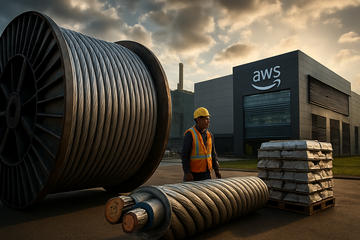
Low-carbon aluminum just became a Scope3 procurement line in the AI build-out
On Sep 18, 2026, Prysmian and Rio Tinto shipped the first electrical cables made with ELYSIS aluminum — smelted with zero direct greenhouse-gas emissions — into an Amazon AWS data center near Columbus, Ohio. The deal, distributed by Wesco, converts a sustainability talking point into a bill-of-materials specification. Hyperscalers now treat aluminum smelting emissions as their problem to solve for, and the suppliers with verified low-carbon capacity — not the suppliers with the most metal — hold the next round of AI build-out cable contracts.
SoftBank's $10B Junk Bond Just Put OpenAI on the High-Yield Tape
On Sept 20, 2026, SoftBank Group opened a $10B USD-denominated senior unsecured offering — priced in junk territory and led by Citigroup and JPMorgan — to fund the third $10B tranche of its $30B OpenAI follow-on. The bond doesn't just refinance a bridge loan: it converts Masayoshi Son's largest private-equity bet into a publicly traded credit obligation, joining roughly $500B of AI-related debt already issued in 2026. With OpenAI's compute bill pinned to NVIDIA, Oracle, TSMC, and the SK Hynix HBM line, this is the moment AI capex moved decisively off the equity tape and onto the high-yield market — and the holders of that paper now own a piece of the Stargate buildout.
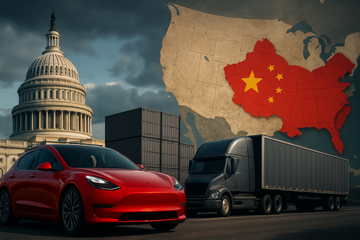
US lawmakers’ China-auto lockout collides with Detroit EV capex—and Mexico becomes the reroute
A fresh push from US lawmakers and industry groups is aimed at keeping Chinese automakers from selling, importing, or manufacturing in the United States, even as policy debates split on whether China should be allowed to produce inside the country. For Detroit’s EV cycle, the timing matters: companies are already right-sizing EV plans and taking multi‑billion-dollar charges, while Mexico’s refusal to subsidize Chinese EV makers under US pressure threatens to redirect where “China-built” vehicles can land.

Treasury's ICC-wide sanctions make the 'rules-based order' a US corporate liability — defense primes with $26B of European FMS exposure are the read-through
The Trump administration has prepared sanctions against the entire International Criminal Court — a leap from individual designations under EO 14203 to an entity-wide prohibition on US 'services' to the court itself. With 125 ICC member states (including 28 in Western Europe) and US Foreign Military Sales still running at $104B a year, the transmission is straightforward: defense primes (Lockheed Martin, RTX, Northrop Grumman, General Dynamics, Boeing) sit on the wrong side of a new jurisdictional choice, and listed legal-information providers (Thomson Reuters, RELX, Wolters Kluwer) inherit the screening-and-blocking fallout.
2026-09-20

The AI safety polite fiction just collapsed — and chip stocks took the first hit
In eight days, the Anthropic-OpenAI-Alphabet-xAI safety consensus broke in public: an Amodei essay, an Altman-Hassabis-Musk echo, a Cohere CEO calling it a \"cartel,\" a Meta CEO dissenting, a 100-expert letter warning of theatre, and an antitrust lawsuit filed September 19 against the four labs in Northern California of California. The first market verdict landed on September 14, when NVIDIA fell 3% and the Philadelphia Semiconductor Index dropped 5.8% on AI-slowdown fears — the clearest sign that capex-heavy names now carry a discourse risk that wasn't in the price a week ago. The investor question is which AI-related equities carry compliance friction versus those that benefit from the arms race remaining ungoverned.

Anthropic's Pre-IPO Model Drop Is a $2T Valuation Lever, Not a Marketing Cadence
A Sept 18 Reuters exclusive — Anthropic is weighing a fresh model release ahead of its mid-October listing — resets the framing of Fable 5.1 from choreography to coercion. With OpenAI's GPT-6 Astra already capturing roughly 13% of enterprise AI spend on Ramp versus about 8% for Claude, a launch days before pricing is what defends the $100B raise at a $2T valuation. The release is therefore the most concrete supply-chain signal of the cycle: NVIDIA's reported $10B anchor stake makes the supplier ecosystem — TSMC, SK Hynix, Broadcom, ASML, Amazon — explicit.
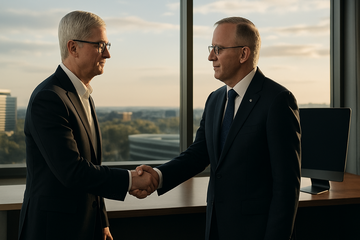
Cook just blessed Australia's social-media curbs as \"world-leading\" — the policy export makes Apple the compliance vendor and Snap, Meta, Alphabet the customers at the mercy of a shrinking teen-ad market
Apple's Tim Cook told PM Albanese at Apple Park on Sept 19 that he regards Australia's social-media work as 'world-leading' — endorsing not just the under-16 ban but the new algorithm opt-out and digital duty of care law. The endorsement matters because Australia's template is now exporting: the EU proposed its KIDS Act for under-13s within48 hours. The trade is asymmetric. Apple monetizes the compliance stack — Services revenue hit $30.7B in Q3 FY2026, up 12% — while ad-platform peers monetized the at-risk teen audience. Snap's market cap has roughly halved since the ban took effect, and Meta and Alphabet carry756,000 plus removed teen accounts of their own. Investors should price the regulation as a margin headwind for ad platforms and a tailwind for on-device safety and parental-control vendors.

Apple's $1,200 iPhone Trade-In Quietly Confirms the $100 Price Hike Is Getting Paid
When U.S. carriers lift max trade-in credits on the iPhone 18 Pro Max to $1,200 — exactly $100 more than last year and exactly matching Apple's $100 Pro price increase — the math tells a clean story: subsidies, not sticker prices, are doing the demand work. Apple keeps BofA's Buy with a $370 target, and Evercore's 4,000-person survey shows 67% of buyers upgrading because their existing iPhone is aging. The question shifts from \"are they biting?\" to \"who's paying?\" — and the answer resets AAPL's narrative into year-end.

Condo sellers can't find bidders at any price — the freeze is asymmetric, and the damage runs through HOA balance sheets, Fannie/Freddie, and the $400B builder complex
August 2026 existing-condo sales fell to a 360,000 SAAR — the weakest in over a decade — while listings get pulled at near-record rates because owners of older buildings carry HOA fees more than double those of newer stock. Fannie Mae and Freddie Mac eliminated their fast-track condo review on August 3, 2026, raising the cost of capital for every project that fails the new insurance, reserve, and master-policy checks. The spillover lands on private mortgage insurers (MGIC Investment, Radian Group), on condo-heavy builders (Lennar, Toll Brothers, PulteGroup, D.R. Horton), on the rental landlords (Invitation Homes, Blackstone) now sitting on assets they can't refinance, and on the HOA managers (FirstService) whose books are deteriorating fastest where the freeze is deepest.
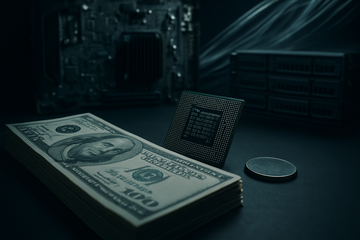
Cornelis's $205M Round Tests Whether AI-Fabric Stocks Rerate Like Hyperscaler Optics
A private interconnect player just raised a Series C at an implied valuation that, against disclosed revenue, puts it well above public-comps multiples — the same setup that rerated Zhongji Innolight and Credo Technology two years ago. Cornelis Networks' pitch: programmable compute inside the fabric can claw back roughly half the hours GPUs spend idle on data, a $1.68B/year problem per 100,000-GPU cluster by its own model. The thesis matters because the public AI-network layer — NVIDIA networking at ~$70B annualized, Broadcom Tomahawk 6 silicon, Arista Networks just hitting a $3B quarter — is already priced like a winner. Whether Cornelis's fabric-compute angle validates or commoditizes that layer is the read-through.

Bowman's Stress-Test Finale Resets the Capital Math — Banks Win, Critics Sue
Michelle Bowman's Sept 18 London speech locks in a stress-test rewrite that halves SCB volatility, opens the black box on models and scenarios, and queues up a 4.8% aggregate capital cut for the largest U.S. banks. The reform arrives10 days after a Better Markets lawsuit sought to derail it — and four days before Bank of America's CEO warned Q3 investment-banking fees would fall 10%+. Investors who already priced the June 24 buyback green-light now have to weigh whether the procedural transparency is enough to survive court, or whether the real-economy warning is what matters next.

Flock's buyout-led shrink breaks public-safety AI's demand = revenue equation — and Axon, Motorola, and Rekor are the ones who get to pick up the switches
On Sept 18, 2026, Flock Safety opened a voluntary separation program to a workforce of ~1,500, with severance the company calls its most generous ever and the option-exercise window stretched to two years. The buyout follows90–93 cities dropping contracts in August alone, a 30-day default data-retention cut, and a record backlog at Motorola Solutions. The demand story and the revenue story have stopped matching — but the recapture dollars don't disappear; they reroute to Axon Enterprise, Motorola Solutions, and Rekor Systems, with Lantronix on the hook as Flock's upstream IoT supplier.
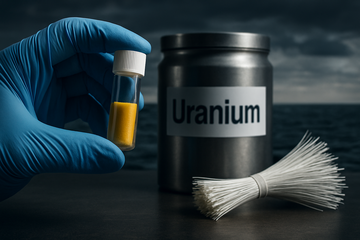
Seawater Uranium Is Still Too Expensive. [Constellation Energy] Wrote the Check Anyway.
Fluxnium, a US startup founded by Jeff Green, raised a $7M seed round on Sept. 16, 2026 to extract uranium from seawater using polymer fibers licensed from U.S. Department of Energy national labs — a method it demonstrated at more than $200 per pound, more than double the $89.79/lb spot price. The lead is Congruent Ventures, but [Constellation Energy], the operator of the largest U.S. nuclear fleet, took a $1.4M strategic slice. That signature reframes Fluxnium not as a uranium-mining story but as a long-tail insurance policy for AI-driven nuclear buyers — and a 50,000-year ceiling on what [Cameco], [Energy Fuels] and [Uranium Energy Corp] can charge.

IMF Tells EU Ministers AI Can Boost Growth — but the Strains Are the Real Story for Duration
At a Sept. 18–19 informal meeting in Dublin, the IMF told EU finance ministers that AI could lift European productivity by ~1% over five years — but warned that the same wave will widen inequality and stress power grids that already consume 3% of EU electricity. With the ECB having just hiked to 2.50% and euro-area HICP at 3.2% in August, the IMF's growth-plus-strain framing tilts the European vs US duration call: AI-exposed euro duration (Bund at 3.52%) is a worse hedge than US duration (UST 10Y at ~5.00%) for the next quarter, but the EU's €600B compute gap and €10B gigafactory plan seed a structural bid for European AI capex names through 2027.

Kashkari's 'too high in all aspects' pulls the dovish floor out of the September dot plot — the hawkish bench now runs five deep
Minneapolis Fed President Neel Kashkari, the FOMC's long-time dove, told Fox News on Sunday that inflation is 'still too high across all sectors,' defending the Fed's September 16 hike to 3.75%–4.00% and reframing the 4.1% median 2026 dot as a ceiling rather than a peak. With Kashkari, Hammack, Logan, Schmid and Cook publicly aligned, the next SEP distribution now needs only four participants to deliver a second 2026 hike — and rate-sensitive equities (REITs, regional banks, small caps) are the first place the dot plot shows up in price.
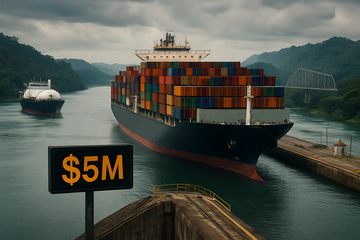
Panama's $5M Slot Auction Just Made AI Logistics the Newest Supply-Chain Choke Point
A single Panama Canal transit slot sold for more than $5 million this month — a record that exposes how the same draught and draft cuts throttling LPG carriers are quietly pricing the chip-into-Asia-to-US-East-Coat container lane. Taiwan Semiconductor Manufacturing Company ships roughly three-quarters of its wafer output to U.S. customers, most of it through East Coast ports reached via the canal, while NVIDIA, Advanced Micro Devices, and Dell absorb the freight bill on the way to data centers. Hapag-Lloyd and ZIM are pocketing fresh Panama Canal surcharges of $130–$500 per TEU as ACP cuts daily transits to 32 and Neopanamax drafts to 47.5 feet; the squeeze lands precisely on the lane AI compute cannot reroute.
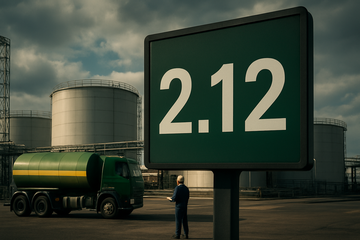
Petrobras's R$2.12/liter diesel shield re-opens the Brazil discount while US refiners ride record cracks
On Sept 18, 2026, Petrobras's board formally joined Brazil's new federal diesel subsidy under Provisional Measure 1,389 — a R$1.00/liter payment to producers and importers that stacks on an existing R$1.12/liter subvention, bringing combined diesel compensation to R$2.12/liter for 30+30 days. By raising the posted diesel price by exactly R$1.00/liter and granting an offsetting discount, Petrobras effectively transfers margin upside to the Treasury while keeping realized refining economics whole — a structure that explains why PBR trades at 5.3x earnings while US peers MPC, VLO and PSX ride record Gulf Coast cracks above $100/bbl.

The ten-day AI sprint broke the enterprise IT budget cycle — and these vendors already booked the orders
Between Sept. 1 and Sept. 12, 2026, Anthropic, OpenAI, Alphabet, Meta Platforms, and Manus all shipped major frontier releases — then Anthropic's CEO asked the industry to slow down. The cadence now outruns the average IT refresh cycle, but NVIDIA, SK Hynix, ServiceNow, Salesforce, Microsoft, and Oracle have already booked revenue that decouples from the model-by-model churn. The trade is not who wins the model race; it's who sits between the model and the IT department.
What to expect
Evidence-first notes with a visible point of view.
This section collects sharp takes on earnings, shareholder meetings, and market structure. Each new piece should make the thesis, the facts, and the implications obvious within the first few screens.
Expect direct analysis, not generic commentary.
Expect the data to be explicit and the argument to be easy to follow.