Latest
The day's market news, with the argument attached
New notes every trading day on earnings, policy and market structure. Each one opens with the conclusion, then the evidence, then the companies it hits.
2026-09-16


Goldman's FICC Softens Into the Fed's First Hike in Three Years — the Trading-Desk Read That Pre-Everyone Else
Goldman Sachs CEO David Solomon told the Barclays conference on Sept 16 that Q3 FICC will be 'slightly softer' than the $4.59B record-equivalent Q2 print, while flagging equities as 'very strong' and warning that Q3 non-compensation expenses will run $500M+ above Q2 — a larger EPS hit than the FICC step-down. The same morning, the Fed lifted rates 25bp to 3.75-4.00%, the first hike since 2023, and the 10-year sits at ~5% with MOVE at83. Bank of America had already warned two days earlier that Q3 sales & trading would be flat versus $5.4B in Q3 2025. Read together, the tape is telling investors the Q3 trading-desk story: FICC softness is the new baseline, equities are the offset, and the expense base is the bigger drag — a setup that reshuffles value across Morgan Stanley, JPMorgan, Citigroup and the electronic-bond infrastructure of Intercontinental Exchange, CME Group, Tradeweb and MarketAxess.
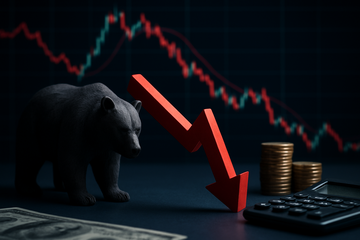
Hedge Funds Crowded Net-Short Consumer Right Into the Fed's First Hike in Three Years
Hazeltree's August 2026 Crowding Report shows 9 of the 20 most-shorted North American large- and mid-cap stocks are now consumer names—up from 4 in July—with Kimberly-Clark, DoorDash and Keurig Dr Pepper joining the top tier. Funds were loading these shorts the same month Chair Kevin Warsh's Fed delivered the first rate hike since July 2023 and oil jumped on the Middle East war. The tape is a positioning trade, not a fundamentals one: staples are still up double-digit YTD, the AI-infrastructure short list keeps expanding, and Alphabet's long-to-short ratio just flipped below parity for the first time this year.

Meta's Camera-Free Glasses Are a Privacy Ploy That Doubles as a Distribution Weapon
Meta's fall-launch 'Luna' glasses strip the camera that made Ray-Ban Meta controversial, betting that voice-only AI and the EssilorLuxottica store network can widen the installed base in a year when Apple is still absent and a $16.68 billion privacy settlement has rewritten the regulatory cost of having a lens in every face. The play defends Meta's 69.2% smart-glasses share, keeps suppliers like Qualcomm, Luxshare, and Goertek at full throttle, and turns litigation exposure into a product moat.

Microsoft vs. Anthropic's \"Consciousness\" — The Personality Clash Reshapes a $2 Trillion IPO and Microsoft's Silicon Bet
Microsoft AI CEO Mustafa Suleyman's public rebuke of Anthropic's Claude \"constitution\" — escalated this month with a 37-page Humanist AI Code of Conduct that rejects model \"legal personhood\" — landed directly between Anthropic's mid-October IPO at a $2 trillion target and Microsoft's Maia 300 chip reveal in September. The spat is the first open personality clash between the two labs and exposes a structural tension: Microsoft is simultaneously Anthropic's $30 billion Azure customer, an equity investor, and now its loudest philosophical critic. Investors should read the spat as positioning trade, not personality drama — the moat it's defending is Anthropic's enterprise share, and the silicon it's threatening is Nvidia's.

New York's $1M-per-MW Rule Turns AI Capacity Into a Political-Credit Trade
Governor Hochul's new Host Community Investment Framework pairs a 50-MW permitting freeze with a recommended $1 million per megawatt community investment benchmark — turning New York's roughly 10 GW data center pipeline into a bidding contest for local political capital rather than a pure interconnection queue. Vendors whose orders are priced for speed and operators concentrated in New York/New Jersey carry the most direct exposure; alternative markets such as Virginia and Texas absorb the marginal projects.

OpenAI's $1.2T Pre-IPO Round Resets the Ceiling — And the S-1 Math Has to Catch Up
Financial Times reports OpenAI is weighing a private round at roughly $1.2 trillion — a 41% step-up from the $852B post-money mark set in March on the same ~$40B annualized revenue base. The implied 30× sales multiple now sits a wide band above Anthropic's ~20.5× and the largest listed AI peers, while $38.5B of 2025 net losses and a $300B Oracle Stargate commitment keep the burn-to-revenue ratio near one-to-one. For public investors, the question is no longer whether the AI premium survives a listing — it's who gets paid in the meantime.

The Senate Just Killed the CLARITY Act. The Companies It Was Supposed to Disrupt Won Anyway.
The Digital Asset Market Clarity Act failed its September 15 cloture vote 10 votes short, freezing the legislative path for 2026. The winners of that failure are the regulated-rails incumbents the bill would have formalized competition against — Coinbase, Circle, and BlackRock — because the regulatory void keeps locking in the status quo they already dominate, while Strategy and other narrative-driven equities lose the catalyst that was underwriting their multiples.
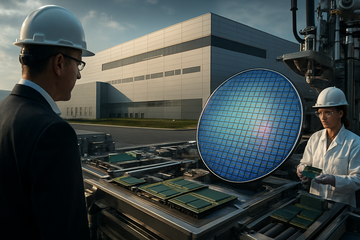
SK Hynix takes Intel's Ohio shell off Intel's hands — the first US memory fab, a counter-cyclical play that re-routes AI memory supply
A September 16, 2026 Reuters exclusive reports SK Hynix is in talks with Intel to lease part of Ohio's stalled $28B One campus, or form a JV with cloud giants, to manufacture DRAM, NAND, and HBM on US soil for the first time. The deal flips the CHIPS Act playbook from logic-first to memory-first, hands a delayed [Intel] asset a paying tenant at a moment when [Intel] Foundry is bleeding $2B a quarter, and gives the lithography, etch, and chemicals complex a new US-anchored memory customer without changing the HBM oligopoly's pricing power in2026–27.

Apple and HP Can Eat the Memory Bill. Xiaomi and Transsion Can't.
Combined Samsung Electronics and SK Hynix memory inventories fell below 10 days as HBM4 absorbs ~3× the wafer capacity of standard DRAM, and the squeeze runs into 2027. Memory now eats ~35% of HP's laptop BOM and over 60% of a sub-$400 smartphone's BOM — a margin shock Apple and HP can pivot around, but smaller OEMs like Xiaomi and Transsion cannot. The trade is the memory oligopoly versus a smaller, more concentrated consumer-hardware market that emerges by 2028.

Pentagon Confirmed Weapons in Orbit. The Real Trade Is the $185B Contract Pipeline and a Four-Supplier Bottleneck.
Air Force Secretary Troy Meink's Sept. 14 confirmation that the U.S. has deployed 'on-orbit space control weapons' landed five months after the Space Force awarded $3.2B in Golden Dome space-based interceptor contracts to a dozen primes and newcomers, plus roughly $6.45B in Starshield/SB-AMTI work to SpaceX. The investable story isn't the disclosure itself — it's a ~$185B program ramping into a defense industrial base where Lockheed Martin is guiding Space segment sales to $13.85B–$14.05B in 2026 on a 632% planned satellite-delivery increase, and where the entire qualified optical inter-satellite link supply chain runs through four companies.

Starbucks Floats a $2.5B Japan Stake Sale — The Royalty Cliff That Rewrites Its International Math
Six months after closing the $4B China joint venture with Boyu Capital, Starbucks is weighing options for its Japan business at a ¥400–500B ($2.5–3.1B) price tag — its largest and most profitable wholly-owned international market. A 60% carve-out would mirror the China playbook: cash in at peak multiples, keep the brand and IP, harvest royalty economics for a decade. The math crystallizes the bull case for the asset-light franchise model — but it also exposes the flip side. Once Starbucks trades Japan for cash, international growth stops being a same-store-sales story and becomes a capital-recycling one, with the U.S. turnaround left to do the heavy lifting.
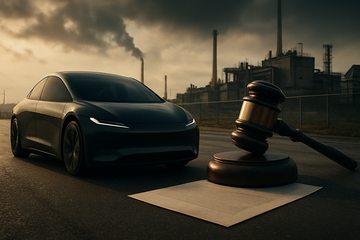
Tesla's Cybercab Self-Cert Bet Just Hit a 20-Day Clock — and a $139M Hammer
Six days after opening Audit Query AQ26002, NHTSA fired a 21-request Special Order at Tesla demanding under-oath answers on whether the no-wheel, no-pedal Cybercab actually complies with the FMVSS it claims to meet. With a September 30 deadline, up to $139 million in civil penalties, and federal FMVSS rules that explicitly assume a human foot on the brake, the self-cert path Tesla picked to dodge the 2,500-vehicle Part 555 cap is now the path most exposed.
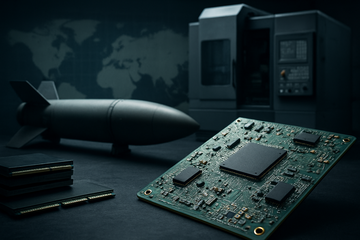
Ukraine's Chip Disclosure Cuts the Other Way: US Memory Dominates Russian Missiles, but Korea's SMEC Just Got Named
Ukraine's Aug. 26, 2026 disclosure undercut the 'Asian chips in Russian missiles' narrative — US semiconductors outnumber Chinese ones, and Beijing's tech was called 'not relevant.' But a quieter Nov. 17, 2025 HUR release specifically named Samsung Machine Engineering Company, a S. Korean CNC maker feeding Russian missile plants, and the US already fined Applied Materials's Korean unit $252M for re-exporting fab gear to a sanctioned Chinese chipmaker. The real exposure for SK Hynix and Samsung Electronics is not memory chips inside warheads — it's the grey-market conveyor that runs through Hong Kong, Shenzhen, and 13 named Japanese suppliers into Russian weapon lines producing 11,000 strike drones a month.

Diesel Just Made Rail the Cheaper Lane: Quantifying the 2026 Truck-to-Rail Modal Trade
Union Pacific CFO Jennifer Hamann publicly confirmed the modal shift on Sept. 16, 2026, the same week EIA diesel hit a record $5.967/gal. With truckload cost-per-mile now north of $0.81, intermodal economics have flipped decisively toward rail — CSX and NSC posted 9% and 5% intermodal volume growth in Q2 2026 while JBHT's fuel bill jumped 53%. The first quantifiable margin trade of 2026 is rail over truck.

BNEF: US Data Centers Could Burn More Gas Than Germany and Japan Combined by 2035
BloombergNEF's New Energy Outlook 2026 says AI data centers will add ~15 Bcf/d of US natural-gas demand by 2035 — roughly matching Germany and Japan's combined current consumption — making US data centers the world's fifth-largest gas user. The 117% upward revision from BNEF's December forecast destroys the 'clean AI' narrative and re-prices gas-turbine OEMs, midstream pipelines, and behind-the-meter IPPs as structural beneficiaries while pressuring hyperscaler net-zero pledges.

Musk Is Sleeping in a Trailer to Get xAI's Next Gigawatt Online — What That Tells the AI Compute Trade
On September 15, Elon Musk said he is living in an Airstream trailer in Memphis to personally oversee what he called xAI's \"biggest expansion yet\" — a Memphis-to-Southaven buildout that takes the combined Colossus cluster to roughly 2 gigawatts and ~555,000 GPUs. The same playbook Musk ran on the Model 3 line now applies to compute, and it is already reshaping the supply chain: NVIDIA is guiding to $108B of Q3 revenue on Blackwell, Alphabet and Amazon-backed Anthropic are paying SpaceX ~$26B a year for capacity, and Tesla' Megapack division has become the project's battery of choice.
2026-09-15

Profound's $1.8B Tag Puts a 265x Multiple on AI-Visibility Software—and Forces Martech Incumbents to React
Profound closed a $180M Series D at a $1.8B valuation on September 15, 2026—less than seven months after its $96M Series C at $1B—putting a roughly 265x multiple on its ~$6.8M 2025 revenue and making AEO (answer-engine optimization) the first AI-native marketing category priced by private capital. The round forces a re-read of HubSpot's April AEO launch, Adobe's $1.9B Semrush acquisition, and Salesforce's Agentforce moat—and tightens the supply-chain link to OpenAI's $100M-ARR ad pilot, Alphabet's AI Mode, and Reddit's data-licensing business.
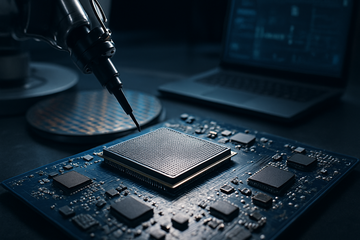
Axelera's Europa Hits EU AI Factories—Not U.S. Hyperscalers. The Foundry and OEM Links Tell the Real Story
Axelera AI shipped its second-generation Europa inference chip and signed 'tens of millions' of dollars in AI-factory contracts on Sept. 15, but the buyers are EU governments, Dell Technologies-led consortia and validated OEMs—not Microsoft, Amazon or Alphabet. The supply chain now has real exposure: TSMC and Samsung Electronics as foundries, Andes Technology for RISC-V control, and Dell and Supermicro as the validated OEM channels. With a $1.5B sales pipeline against 'tens of millions' in signed deals, the question for investors is how much of Europe's €30B AI gigafactory program converts into inference-ASIC orders.

Anthropic just asked the world to slow AI. Its biggest chip supplier says the order book hasn't moved.
On Sept 14 Broadcom CEO Hock Tan told CNBC that AI revenue targets are unchanged after Anthropic CEO Dario Amodei's essay calling to \"slow the pace\" of frontier model development — and that Anthropic is on track to become Broadcom's largest custom-chip customer in 2027. The cross-check matters: the same lab asking for a pause has already committed to roughly $42B of Broadcom silicon for next year, per Mizuho's read of the April compute deal. For the AI infrastructure trade, the Sept 14 selloff priced the PR risk; the order book argues the supply chain is not slowing — and the chip vendor is now the loudest voice saying so.

Delos Data's $100M Round Confirms It: The AI Bottleneck Has Moved from the GPU to the Wire
A former Intel networking team raised $100M on Sep 15, 2026 to build AI fabric chips — and the round's investor list (Pat Gelsinger's Playground, Matrix, Socratic, Capricorn) signals where the next dollar of AI capex is going. With Broadcom posting $16.7B of AI semiconductor revenue in Q3 FY2026 (+221% YoY) and Dell'Oro forecasting ~$1T in AI back-end switch spending through 2030, the bottleneck is no longer the GPU — it's the interconnect. The listed winners are the merchant silicon trio (Broadcom, Marvell, Astera Labs), the system houses (Arista Networks), and the optical component stack (Credo Technology, Lumentum, Coherent).
What to expect
Evidence-first notes with a visible point of view.
This section collects sharp takes on earnings, shareholder meetings, and market structure. Each new piece should make the thesis, the facts, and the implications obvious within the first few screens.
Expect direct analysis, not generic commentary.
Expect the data to be explicit and the argument to be easy to follow.