Latest
The day's market news, with the argument attached
New notes every trading day on earnings, policy and market structure. Each one opens with the conclusion, then the evidence, then the companies it hits.
2026-09-22

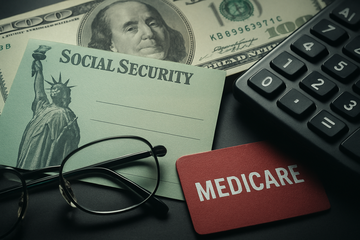
The 'No-Tax-on-Social-Security' Promise Skips the 88% Who Already Paid Nothing — the 3.6% 2027 COLA Won't
President Trump's headline 'no tax on Social Security' arrived as the 2027 COLA shaped up at roughly 3.6%, but the Working Families Tax Cuts Act machinery is a temporary $6,000 senior deduction that the Tax Foundation shows actually delivers a larger after-tax lift to lower-middle-income retirees than the original promise would. The COLA is the bigger investable event: about $70 a month extra on ~71 million checks flows straight into UnitedHealth Group, Humana, Welltower, Ventas, and the senior-skewed staples trade — not into the retirees the messaging targets.

Obamacare's 750K Purge Leaves a Sicker, Smaller Pool — Insurers Catch a Margin Tailwind, Hospitals Catch a $1B Payer-Mix Hit
The Vance-led task force cut 760,000 from ACA exchanges at the end of August and flagged 419,000 more for verification, claiming $2.2B in taxpayer savings. The same-day market response was surgical: Oscar Health fell as much as 6.6%, Centene 3.9%, Molina Healthcare 3.5% — but the bigger story is the asymmetric second-order effect. Healthier enrollees disproportionately leave exchange coverage, the sicker pool remains, and Centene just raised its 2026 marketplace pretax-margin guide to 4.5%–5%. Hospitals bear the offsetting cost: HCA Healthcare now sees a $1B–$1.2B full-year payer-mix hit, with Tenet Healthcare exchange revenue down 17% and Community Health Systems self-pay rising above 6% of visits.

Trump's Diesel Export Ban Floats In. The $12.6B Refiner Trade Just Met Its First Real Policy Risk.
President Trump said on Sept 22 that he would support banning US diesel exports as pump prices hit a record $6.52/gal. The threat lands directly on Marathon Petroleum, Valero and Phillips 66 — whose combined Q2 net income of $12.6B was built on distillate cracks that are already near all-time records. A ban would not lower US pump prices because diesel is globally priced off Europe and Russia (where exports are already banned), but it would force refiners to cut runs and spill gasoline and jet. The investable pivot sits elsewhere: Union Pacific, CSX and Norfolk Southern already see truck freight converting to rail as diesel tops $5/gal — and a ban only accelerates that modal shift.
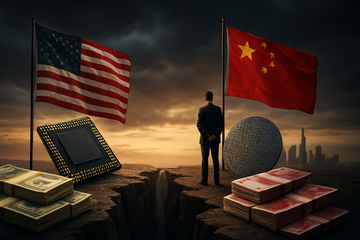
The AI Trade Is Already Splitting — Two Days Before Trump and Xi Sit Down
President Trump's Sep 24 summit with Xi Jinping hasn't happened yet, but the bifurcation is live: the Sep 20 Bessent–He Lifeng talks in New York locked in a US-China AI safety dialogue while explicitly carving chip export controls out of it, leaving the H200 pipeline to NVIDIA stuck at zero deliveries. NVIDIA itself guided Sep-quarter revenue of $108B with zero China data center compute baked in, while Chinese/HK investors crossed $750B in US equity holdings and US banks underwrote $17.2B of Chinese AI listings — investors are hedging both sides rather than picking one.
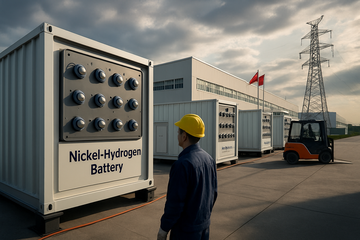
EnerVenue’s Changzhou start exposes the real constraint on “Made-in-USA” batteries
EnerVenue’s first high-volume nickel-hydrogen battery production in China starts the same day Trump meets Xi—showing that speed, industrial depth, and proven manufacturing know-how can outweigh industrial-policy promises. The move also highlights a supply-chain split: US policy may redirect demand, but China’s production engine is where new battery platforms are getting industrialized first.
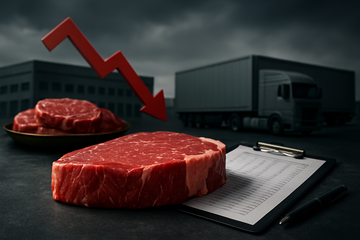
Wendy's Just Watched Its Largest U.S. Franchisee File Bankruptcy — Beef Is Now Breaking Operators, Not Just Packers
Meritage Hospitality Group, operator of 314 Wendy's locations across 15 states, filed Chapter 11 on Sept. 17, 2026, citing an 18.9% spike in beef costs as its store-level EBITDA collapsed 48% in 2025 — the first major franchisee casualty of a cattle squeeze that, until now, had been treated as a packer-only story. The bankruptcy exposes a new pressure point: who absorbs the operator's $147 million of Wendy's claims, hundreds of NNN ground leases, and supply contracts, and what that does to Tyson Foods, JBS, and the Four Corners Property Trust-style REITs underwriting Wendy's real estate.
2026-09-21

Yttrium 69x Forced Aerospace's Hand — and the Substitute Order Book Just Opened
Reuters confirms Oerlikon Metco and Canada's NRC are qualifying zirconia-based thermal-barrier coatings to replace rare-earth-laden formulas in jet-engine hot sections. The trigger: yttrium prices up ~69x year-over-year, China's November 2025 truce only partly holding, and the agreement expiring Nov 10, 2026. The money is already moving upstream: MP Materials just signed a heavy-rare-earth aerospace offtake, USA Rare Earth locked $1.6B of federal funding, and Vulcan Elements/Ucore are building a non-China magnet chain under Pentagon cover.
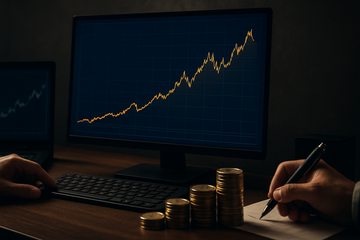
AMD Came Within $50B of the $1T Club — the Near-Miss Tells Us Exactly What the AI Rally's Second Half Requires
Advanced Micro Devices shares peaked at $584.73 on June 30, 2026, putting its market cap at $947B — just $53B shy of the trillion-dollar line — before slipping to $912.84B by mid-September. Five other AI enablers (NVIDIA, Broadcom, Alphabet, Taiwan Semiconductor, Micron) already trade above $1T, leaving AMD as the lone major AI chip designer on the outside of the club despite owning the most-cited customer win of the cycle. With the 6GW OpenAI deal triggering the first 1GW of MI450 in H2 2026, a fresh Meta Platforms warrant, and a $13B Q3 revenue guide in hand, execution risk — not announcement risk — is what the rally's second half now prices.
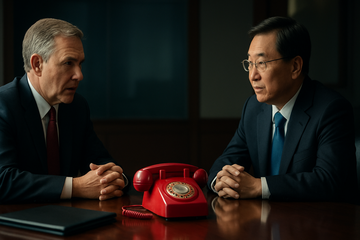
Bessent's AI 'Red Phone' Is the First Concrete He-Bessent Deliverable — and the Real Question Is Who Decides What Counts as an Incident
Treasury Secretary Scott Bessent used his Sept 20 New York meeting with Vice Premier He Lifeng to propose a bilateral US-China AI safety incident notification mechanism — the first trackable deliverable from the May AI dialogue and the first time frontier-AI rivalry has been forced into a bilateral protocol rather than a pure export-control race. With the CISA distillation advisory and Anthropic's 151 million–exchange report against Alibaba already on the table, and chip export controls explicitly off the AI agenda, the mechanism's arbitration rights — not its wording — decide whether US frontier labs (Alphabet, Microsoft, Meta) or Chinese systems (Alibaba, Baidu) get to define 'national security AI incident' first.

China's 200-Boeing Deal Is Still Unfinalized — The Aftermarket Is Where CFM and GE Aerospace Win or Lose
Four months after Trump's Beijing summit, China's 200-aircraft Boeing purchase has not been signed. The bottleneck is no longer price; it is engine-parts and long-term MRO guarantees. That fight rewires who captures the multi-decade service revenue — and turns GE Aerospace's $170B services backlog and CFM International's freshly-certified China LEAP-1C MRO shop into the single biggest investable lever in the deal. With Xi Jinping landing in Washington on September 24, the next 72 hours set the multi-year aftermarket map.
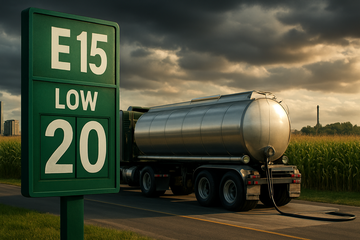
California E15 is now legal in all 50 states — a $1.5B ethanol windfall lands on refiners and station operators before it reaches the corn grower
California became the last state to permit E15 sales after Governor Newsom signed SB 795 on September 19, 2026, completing a regulatory path that began with AB 30 in October 2025. Aemetis pegs the new California ethanol demand at 600–650 million gallons per year — roughly 10× its 65-million-gallon Keyes plant — against $2.7 billion in annual pump savings. The ethanol dollar first runs through Valero Energy's 1.6B-gallon ethanol footprint and a refiner lobby that spent a year blocking the bill; only later does it reach corn processors like Archer Daniels Midland and station retailers such as Casey's.
Unitree's $35 billion wipe just wrote the new rulebook for every Chinese humanoid IPO
After Unitree Robotics lost more than half its market value in the month after its Shanghai debut, China's CSRC began informally vetting humanoid IPO candidates on three points — recurring revenue, a path to narrowing losses, and real industrial demand. The guidance puts 28 queued listings in limbo, advantages profitable parts suppliers like Leader Harmonious Drive Systems and Shenzhen Inovance Technology, and pressures unprofitable pure-plays from UBTECH Robotics to AGIBOT.
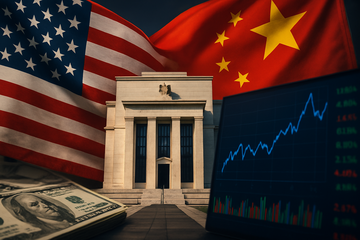
The Fed Just Hiked. China Held LPRs for a 16th Month. The 330bp Bond Spread Tells You Who's Wrong.
The People's Bank of China kept both LPRs unchanged for the 16th straight month on Sept. 20, while the Federal Reserve raised rates 25bp to 3.75%-4.00% five days earlier. The China-US 10-year yield spread has blown out to a record ~332bp, the offshore yuan is the strongest against the dollar since July 2022, and Apollo's Torsten Slok is calling a 'China Shock 2.0' as high-tech exports surge 41%. For investors, the divergence trade is no longer a tactical bet — it is a structural carry regime that punishes anyone short yuan credit and rewards anyone short US duration.
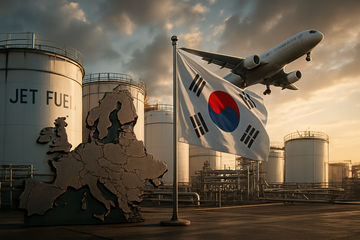
Europe's 510 kbpd Q4 jet fuel gap made South Korea a swing supplier — US transatlantic carriers and Asian refiners split the math
Europe faces a 510,000 bpd Q4 jet fuel deficit as refinery closures and lost Middle East flows drain Amsterdam-Rotterdam-Antwerp stocks to a seven-year low. South Korea-based producers are filling the gap, pushing September flows to Europe to 129,000 bpd — the highest since October 2022 — on the back of a seven-year high in output. The bill lands on US transatlantic carriers operating with little or no fuel hedge: American Airlines flagged roughly $1 billion of incremental Q4 fuel costs, JetBlue is cutting capacity, and United is the only network carrier still profitable into the dislocation. S-Oil, Marathon Petroleum, and Valero collect the other side of the trade, riding $87/bbl Singapore diesel cracks and a $12/bbl structural premium in jet cracks above the pre-Covid average.
Jane Street's $15B loss just landed on bank balance sheets — and the Fed, BoE and SEC are circling
The SEC has subpoenaed Goldman Sachs, JPMorgan Chase, Citigroup and Bank of America over margin lending to AI-focused hedge fund Situational Awareness, and the Fed and Bank of England are now jointly pressing global banks on intraday exposure to trading firms including Jane Street and Citadel Securities. With the BoE already flagging hedge fund equity prime brokerage balances at record levels and up ~40% year-over-year, the July blow-up is converting a private prop-trading loss into a system-wide bank-capital review of prime brokerage — and pulling SK Hynix and Taiwan Semiconductor into the regulatory frame.

Alphabet's $899 Googlebook Hit HP, Dell, and Lenovo on the Worst Possible Day for Consumer PC Volumes
Alphabet on Sept. 21, 2026 opened pre-orders for Googlebook laptops starting at $899, built by Acer, ASUS, Dell, HP, and Lenovo and bundled with a year of Gemini Advanced plus 5TB of cloud storage. The lineup lands on the same day HP's consumer notebook shipments are down 19% with AI PC mix only at 46%, Lenovo is posting record results with 25.1% global AI PC share, and Copilot+ PCs sit at low-single-digit Windows share. Investors should read this as the moment when the AI-PC race becomes a services-subsidy competition, with Qualcomm and Intel splitting the silicon line, Apple's $599 MacBook Neo holding the floor, and Microsoft's Copilot+ thesis suddenly without a clean consumer counter.

Goolsbee's \"No Ambiguity\" Is the Demand-Side Hawkish Anchor the Fed Was Missing
Chicago Fed President Austan Goolsbee told OMFIF in London on September 21, 2026 that strong demand is now adding to inflation alongside supply shocks, and that \"if demand overheats, there is no ambiguity about how the Fed needs to respond\" — explicitly flagging AI data-center capex as a spillover risk. Five days after the Fed's first rate hike since 2023, a unanimous 12-0 vote and a dot plot pointing to a 4.1% median funds rate through 2027, Goolsbee's framing hardens the bar to an October cut and shifts the hawkish anchor toward demand. Banks and gold-linked assets gain ground; rate-sensitive REITs, homebuilders and AI-capex-exposed semis face a higher hurdle.
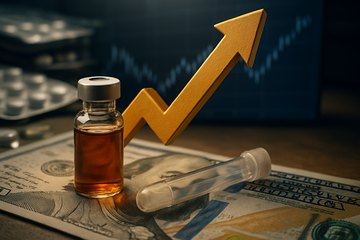
GRAIL Pops 35% on FDA's Quiet Blessing — The Real Test Is Galleri's $949 Price Tag Against a 2028 Medicare Clock
GRAIL shares jumped roughly 35% on Sep 21 after FDA briefing documents ahead of the Sep 23 AdCom raised no analytical concerns on Galleri, but the harder vote sits at CMS, not the FDA. The MCED Screening Coverage Act is already law, yet Medicare reimbursement for Galleri does not begin until Jan 1, 2028, and three competing blood-based cancer screens are already shipping — Guardant Health's Shield, Freenome/Abbott's SimpleScreen, and Exact Sciences' Cancerguard. Illumina's retained 14.5% GRAIL stake is now worth ~$680M on paper, while the stock trades 47% above its 50-day moving average and 34% above the Street's median target.
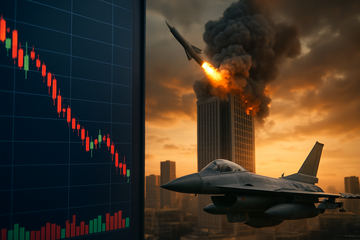
Missiles hit Riyadh and Tadawul fell 0.3% — that gap is where Boeing, Lockheed Martin, and RTX own the re-rate
Houthi ballistic missiles and drones struck the Saudi capital itself on September 19, 2026, hitting fuel storage at King Khalid International Airport — the first direct attack on Riyadh in the renewed Yemen war. Iran's military command responded the next day by warning that any new US attack would trigger 'sustained retaliation' against US bases and interests and that 'Washington's regional allies would be considered parties to the conflict', pulling Saudi Arabia and the wider Gulf into direct retaliation risk. Yet Saudi Tadawul's TASI closed September 20 down only 0.3% at 10,750, with Saudi Aramco reversing an intraday drop to close up 1.3% and Brent crude gaining 0.78% to $104.68 — meaning the political-risk premium is being absorbed by specific names rather than dumped across the index. That re-rates Boeing, Lockheed Martin, RTX, and Northrop Grumman into the cleanest single-name read on whether the standoff escalates, with Chevron and Exxon Mobil collecting the direct Brent beta, while Marriott sits on the wrong side as Gulf travel and conference demand risk a pause.
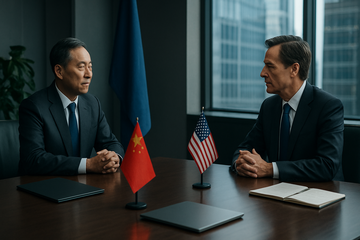
JPMorgan’s HQ just became the White House’s deal-room proxy for US-China talks—watch what that does to finance, AI and critical minerals
A Bessent–He bilateral held at JPMorgan Chase & Co. headquarters (not Treasury or State) underscores that Wall Street is becoming an operational platform for US–China diplomacy on AI security, trade and critical minerals. For investors, the signal is less about “friendlier ties” and more about lower execution friction for cross-border policy packages—a setup that can selectively support chips, memory and rare-earth supply chains while keeping downside pressure on compliance-heavy trading and financing.
What to expect
Evidence-first notes with a visible point of view.
This section collects sharp takes on earnings, shareholder meetings, and market structure. Each new piece should make the thesis, the facts, and the implications obvious within the first few screens.
Expect direct analysis, not generic commentary.
Expect the data to be explicit and the argument to be easy to follow.