Energy
Crude, refining and the price at the pump
Supply, inventories, crack spreads and OPEC decisions, followed down to the producers, refiners and buyers who book the difference.
2026-09-22


Nasdaq Set a Record Six Days Into the Most Hawkish Fed in Three Years — And Chip Stocks Did All the Heavy Lifting
The Nasdaq Composite closed at a record 27,122.09 on September 21, just six trading sessions after Chair Kevin Warsh' first25bp rate increase since 2023 lifted the funds rate to 3.75–4.00% with a unanimous 12-0 vote and a hawkish dot plot. Chips carried the tape: Meta' September 8 launch of its Muse personal AI agent triggered a 4.3% surge in the Philadelphia Semiconductor Index, a12% jump in Intel, a 17% surge in Arm Holdings, and pushed Advanced Micro Devices past $1 trillion in market value for the first time. Meanwhile, a four-day slide in Brent crude to $100.40 — driven by signals that Donald Trump will meet Iran's president at this week's UN General Assembly — drained the inflation impulse Warsh was trying to contain. The message is that the market is pricing structural forces ($1 trillion in global AI investment, hyperscaler capex running at 93% of operating cash flow) more heavily than the policy rate, leaving duration, oil, and select chip names mispriced versus the Fed's own path.

Trafigura's $1.1B Bet Puts Nth Cycle on the NYSE at $585M — Now the Market Has to Price the First US Critical-Minerals Refining IPO
Burlington-based Nth Cycle, the first US refiner turning scrap batteries into battery-grade nickel and lithium at scale, locked a $1.1B, 10-year binding offtake with Trafigura and a US Department of Energy grant of up to $100M before pricing its NYSE debut at a $585M enterprise value. The tag sits between Albemarle's 2.3x and MP Materials's 30x trailing EV/Revenue — and that gap captures the question every US critical-minerals name now faces: whether the 'domestic refining premium' is worth a 3x uplift over a global commodity refiner. The SPAC closes in Q4 2026 and is the first live test of whether Western capital will pay a structural premium for non-Chinese processing.

Trump's Diesel Export Ban Floats In. The $12.6B Refiner Trade Just Met Its First Real Policy Risk.
President Trump said on Sept 22 that he would support banning US diesel exports as pump prices hit a record $6.52/gal. The threat lands directly on Marathon Petroleum, Valero and Phillips 66 — whose combined Q2 net income of $12.6B was built on distillate cracks that are already near all-time records. A ban would not lower US pump prices because diesel is globally priced off Europe and Russia (where exports are already banned), but it would force refiners to cut runs and spill gasoline and jet. The investable pivot sits elsewhere: Union Pacific, CSX and Norfolk Southern already see truck freight converting to rail as diesel tops $5/gal — and a ban only accelerates that modal shift.
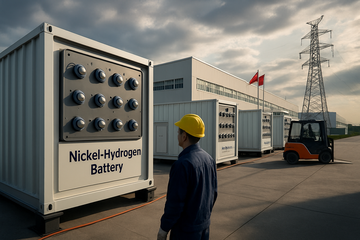
EnerVenue’s Changzhou start exposes the real constraint on “Made-in-USA” batteries
EnerVenue’s first high-volume nickel-hydrogen battery production in China starts the same day Trump meets Xi—showing that speed, industrial depth, and proven manufacturing know-how can outweigh industrial-policy promises. The move also highlights a supply-chain split: US policy may redirect demand, but China’s production engine is where new battery platforms are getting industrialized first.
2026-09-21

California E15 is now legal in all 50 states — a $1.5B ethanol windfall lands on refiners and station operators before it reaches the corn grower
California became the last state to permit E15 sales after Governor Newsom signed SB 795 on September 19, 2026, completing a regulatory path that began with AB 30 in October 2025. Aemetis pegs the new California ethanol demand at 600–650 million gallons per year — roughly 10× its 65-million-gallon Keyes plant — against $2.7 billion in annual pump savings. The ethanol dollar first runs through Valero Energy's 1.6B-gallon ethanol footprint and a refiner lobby that spent a year blocking the bill; only later does it reach corn processors like Archer Daniels Midland and station retailers such as Casey's.

Europe's 510 kbpd Q4 jet fuel gap made South Korea a swing supplier — US transatlantic carriers and Asian refiners split the math
Europe faces a 510,000 bpd Q4 jet fuel deficit as refinery closures and lost Middle East flows drain Amsterdam-Rotterdam-Antwerp stocks to a seven-year low. South Korea-based producers are filling the gap, pushing September flows to Europe to 129,000 bpd — the highest since October 2022 — on the back of a seven-year high in output. The bill lands on US transatlantic carriers operating with little or no fuel hedge: American Airlines flagged roughly $1 billion of incremental Q4 fuel costs, JetBlue is cutting capacity, and United is the only network carrier still profitable into the dislocation. S-Oil, Marathon Petroleum, and Valero collect the other side of the trade, riding $87/bbl Singapore diesel cracks and a $12/bbl structural premium in jet cracks above the pre-Covid average.
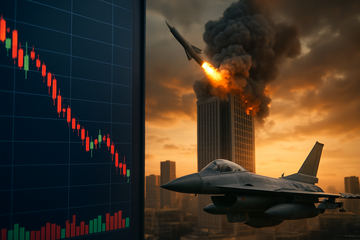
Missiles hit Riyadh and Tadawul fell 0.3% — that gap is where Boeing, Lockheed Martin, and RTX own the re-rate
Houthi ballistic missiles and drones struck the Saudi capital itself on September 19, 2026, hitting fuel storage at King Khalid International Airport — the first direct attack on Riyadh in the renewed Yemen war. Iran's military command responded the next day by warning that any new US attack would trigger 'sustained retaliation' against US bases and interests and that 'Washington's regional allies would be considered parties to the conflict', pulling Saudi Arabia and the wider Gulf into direct retaliation risk. Yet Saudi Tadawul's TASI closed September 20 down only 0.3% at 10,750, with Saudi Aramco reversing an intraday drop to close up 1.3% and Brent crude gaining 0.78% to $104.68 — meaning the political-risk premium is being absorbed by specific names rather than dumped across the index. That re-rates Boeing, Lockheed Martin, RTX, and Northrop Grumman into the cleanest single-name read on whether the standoff escalates, with Chevron and Exxon Mobil collecting the direct Brent beta, while Marriott sits on the wrong side as Gulf travel and conference demand risk a pause.
2026-09-20
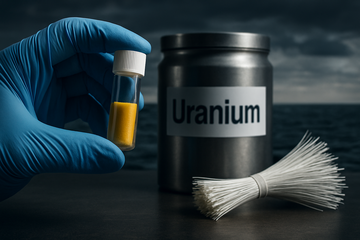
Seawater Uranium Is Still Too Expensive. [Constellation Energy] Wrote the Check Anyway.
Fluxnium, a US startup founded by Jeff Green, raised a $7M seed round on Sept. 16, 2026 to extract uranium from seawater using polymer fibers licensed from U.S. Department of Energy national labs — a method it demonstrated at more than $200 per pound, more than double the $89.79/lb spot price. The lead is Congruent Ventures, but [Constellation Energy], the operator of the largest U.S. nuclear fleet, took a $1.4M strategic slice. That signature reframes Fluxnium not as a uranium-mining story but as a long-tail insurance policy for AI-driven nuclear buyers — and a 50,000-year ceiling on what [Cameco], [Energy Fuels] and [Uranium Energy Corp] can charge.
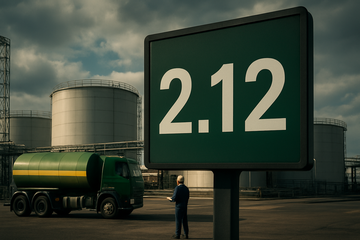
Petrobras's R$2.12/liter diesel shield re-opens the Brazil discount while US refiners ride record cracks
On Sept 18, 2026, Petrobras's board formally joined Brazil's new federal diesel subsidy under Provisional Measure 1,389 — a R$1.00/liter payment to producers and importers that stacks on an existing R$1.12/liter subvention, bringing combined diesel compensation to R$2.12/liter for 30+30 days. By raising the posted diesel price by exactly R$1.00/liter and granting an offsetting discount, Petrobras effectively transfers margin upside to the Treasury while keeping realized refining economics whole — a structure that explains why PBR trades at 5.3x earnings while US peers MPC, VLO and PSX ride record Gulf Coast cracks above $100/bbl.

TotalEnergies Enters Venezuela, but the Real Prize Is Washington’s Next Move
The Sept. 19 memorandum between Caracas and TotalEnergies is strategically important even though its commercial terms remain undisclosed. It breaks the assumption that Venezuela’s reopening would be controlled exclusively by U.S. operators, raising competitive pressure on Chevron while leaving the investment case dependent on sanctions permissions, payment rules and contract execution.
2026-09-18

2026-09-17

Holtec Pulled Its $900M Nuclear IPO One Day Before Pricing — The SMR-to-Data-Center Story Just Met the Public Markets
Holtec Nuclear suspended the year's most-watched pure-play nuclear listing on September 16, 2026, after its $900M, $15-$18 range failed to find a clearing price against a 35%-off-the-high nuclear ETF, a -36.7% post-IPO X-Energy, and a -20.6% post-IPO Standard Nuclear. The signal is not that hyperscalers have stopped buying power — Microsoft, Meta and Walmart keep signing PPAs — but that the public market is no longer willing to underwrite multi-year SMR capex at 17x revenue with 2029 NRC approvals and zero commercial reactors in service. Pre-revenue reactor developers NuScale and Oklo are down 85% and 82% from their 52-week highs; the real test now is whether the upcoming Westinghouse IPO at a rumored $30B can clear.

Heeney's Gold Concession and Continental's Orinoco MOU Landed on the Same Day at G20 Houston—That's the First US Private-Capital Footprint in Caracas Since 2019
On Sept. 16, 2026, Heeney Capital signed a mining concession for Venezuela's El Callao gold district and Continental Resources signed an MOU with PDVSA for the 30 billion-barrel Ayacucho 2 Block—both announced at the G20 Energy Abundance Ministerial in Houston. The two deals arrive two weeks after the US-NABEP agreement gave Washington a 35% equity stake and 20% off-take rights across 17 Venezuelan fields with ~65 billion barrels of P1 reserves, and a month after Chevron committed $7 billion to double production by 2031. The investable footprint is no longer just Chevron—it now extends to oilfield services (SLB, Halliburton, Baker Hughes), heavy-crude Gulf refiners (PBF Energy, Valero, Marathon Petroleum), and mining-equipment makers (Caterpillar).
2026-09-16

Diesel Just Made Rail the Cheaper Lane: Quantifying the 2026 Truck-to-Rail Modal Trade
Union Pacific CFO Jennifer Hamann publicly confirmed the modal shift on Sept. 16, 2026, the same week EIA diesel hit a record $5.967/gal. With truckload cost-per-mile now north of $0.81, intermodal economics have flipped decisively toward rail — CSX and NSC posted 9% and 5% intermodal volume growth in Q2 2026 while JBHT's fuel bill jumped 53%. The first quantifiable margin trade of 2026 is rail over truck.
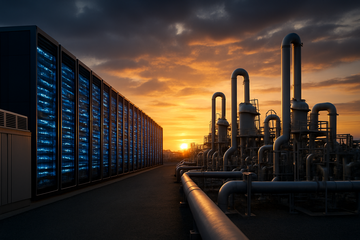
BNEF: US Data Centers Could Burn More Gas Than Germany and Japan Combined by 2035
BloombergNEF's New Energy Outlook 2026 says AI data centers will add ~15 Bcf/d of US natural-gas demand by 2035 — roughly matching Germany and Japan's combined current consumption — making US data centers the world's fifth-largest gas user. The 117% upward revision from BNEF's December forecast destroys the 'clean AI' narrative and re-prices gas-turbine OEMs, midstream pipelines, and behind-the-meter IPPs as structural beneficiaries while pressuring hyperscaler net-zero pledges.
2026-09-15

2026-09-14

Exxon's 264,000-bpd Joliet Refiner Just Went Dark — and the Curve Can't Afford to Lose Another Drop
Exxon Mobil's 264,000-bpd Joliet, Illinois, refinery tripped offline on a power outage Sunday at 3:30 p.m. CT, knocking ~10% of Midwest finished-product supply out of action while diesel cracks already sit above $100/bbl and the Saudi East-West pipeline remains dark. The outage stacks on top of a Strait of Hormuz disruption, a 5–6 week Saudi pipeline repair, Trump's public push on Volodymyr Zelensky to spare Russian diesel, and 280,000 bpd of West Coast capacity already gone — turning any unplanned US drop into a crack-spread accelerant. Refiners running full tilt are the cleanest expression: Marathon Petroleum booked $24.84/bbl R&M margin in Q2 versus $6.79 a year ago, and the seven-stock US refining complex is up 80–190% YTD with another leg higher priced in if Joliet stays down past the IIR estimate of end-of-week restart.

Saudi Just Yanked 4% of Global Oil at $102 Brent. The Curve Says This Is a Spike—Unless the Pipeline Doesn't Restart in 3 Days
Saudi Aramco's East-West pipeline shutdown, triggered by Iraqi-launched drone strikes on September 10–11, has pulled 4–5 mb/d — 4–5% of global supply — off the market while Brent trades ~$107 on the front month and Dec 2027 already discounts to $78. The deep backwardation argues for a fast spike, not a new floor: Saudi Arabia repaired a missile hit on the same pipeline in just 3 days in March 2026, and IEA data shows effective Saudi spare capacity at exactly 0 mb/d. The market is pricing in repair — duration of the outage is the single binary catalyst.

From sanctions to shareholding: Trump's Venezuela template puts Iran's 208 billion barrels on the table
On September 13, President Trump explicitly framed the Iran endgame as 'keeping the oil like Venezuela' — a state-shareholding template, not a sanctions regime. The September 2 Venezuela deal hands U.S. operators majority control of 65 billion barrels at low-cost off-take, with Chevron pledging $7 billion to double output to 600,000 bpd. Applied to Iran's 208.6 billion barrels (per OPEC's 2026 bulletin), the template rewrites Chevron's barrel math, flips the oilfield-services cycle, and gives U.S. Gulf refiners a heavy-crude cost basis the market has not priced.
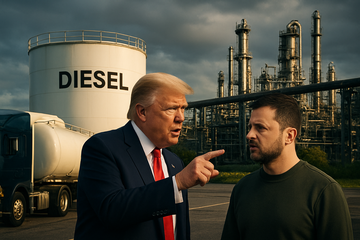
Trump Tells Zelensky to Spare Russian Diesel — Right as Marathon Petroleum, Valero and Phillips 66 Pocket a $5.1B Quarter
On Sept. 13, 2026, President Trump publicly told Ukraine to 'stop knocking out diesel fuel in Russia,' even as the U.S. diesel crack spread hit a record $108/bbl and the three largest independent refiners booked combined Q2 refining-segment income north of $15B. The call reframes diesel from a Russia-Ukraine story into a U.S. policy lever — and ties the U.S. refiner P&L, Saudi pipeline flows, and any Trump-Putin-Xi deal into a single crude-distillate trade. The squeeze itself is bigger than Kyiv: the IEA says the U.S.-Iran war has removed more supply, with the Strait of Hormuz historically carrying 20% of global oil and the Saudi East-West pipeline now offline after a Sept. 11 Houthi drone strike.
What to expect
Evidence-first notes with a visible point of view.
This section collects sharp takes on earnings, shareholder meetings, and market structure. Each new piece should make the thesis, the facts, and the implications obvious within the first few screens.
Expect direct analysis, not generic commentary.
Expect the data to be explicit and the argument to be easy to follow.