Policy & Trade
Tariffs, export controls, and who absorbs them
Rulings, sanctions and trade negotiations traced to the companies that pay for them — margin by margin, route by route.
2026-10-25

October 24, 2026: A $5 Quote Cap and a Mandatory Failover Reprice the Top of the Book
Two hard deadlines landed on the same Saturday, and neither is a new SEC rule. Cboe Global Markets's tiered maximum market-maker quote differential became operative on Oct. 24, 2026, while Regulation SCI Rule 1004 put the largest venues, clearing houses and their designated members through a coordinated business-continuity failover. Both raise the fixed cost of staying in the market, which taxes the marginal participant and pushes flow toward the biggest venues and the biggest wholesalers. For investors the trade is a scale premium: Nasdaq and CME Group monetise the volume wave while absorbing a trivial compliance bill, while Robinhood Markets carries retail-transaction revenue that depends on the spread capture these rules compress. The pending proposal to rescind Rule 611 remains the catalyst that decides how wide that gap gets.

350 Homes Is the New Wall: Treasury's January 7, 2027 Ban Forces Single-Family REITs to Build, Not Buy
Treasury's proposed rule, published Oct. 23, 2026, would bar any entity controlling 350 or more single-family homes from buying existing houses from Jan. 7, 2027, while exempting build-to-rent, renovate-to-rent and transfers between large institutional investors — a ban on one exit, not on ownership. The bid for housing does not disappear; it moves to builders and construction lenders, which turns single-family rental into a development and financing business and makes capital, not rents, the thing that re-prices. The two largest landlords were already net sellers, and their own filings flag the real risk: reduced access to capital markets. Own the exempt channel and the lenders who finance it; be cautious on the landlords whose growth depended on buying houses someone else can no longer buy.
Britain's £200m Model-Credit Deal Is Too Small to Move OpenAI or Anthropic — and Buys Them Influence Over UK Biosecurity Policy
On Oct 24, 2026 the UK unveiled the world's first dedicated AI biosecurity organisation: £100m of public money plus up to £200m of model credits and compute pledged by OpenAI and Anthropic. Priced at the pound-dollar rate Reuters used for the same package, those credits are worth roughly $267m — about 3% of the compute Anthropic burned in the first half of 2026 and 1.6% of its third-quarter revenue. So the pledge cannot be a revenue event; it is a regulatory one, struck eleven days after both labs told a UK parliamentary committee that voluntary pledges no longer worked. Governments are now anchor customers of the frontier labs, and they pay in capacity rather than cash. For public-market investors the exposure runs through utilisation of already-financed compute — CoreWeave, Microsoft, Amazon, Nvidia, Alphabet, SK hynix — not through new chip orders, and the fragility sits in the GPU lessor's balance sheet, not the labs'.

Illinois Put a $5,000-a-Head Price on Face Scans. Two Grok Suits Show Why Consumer AI Now Has to Price That In
Two Illinois class actions filed five days apart in October 2026 allege that Grok's ordinary photo features — rate a selfie, edit a face, measure a jaw — are unlawful biometric \"scans of face geometry\" under a state statute that awards up to $5,000 per person per violation. Because a federal appeals court held in April 2026 that Illinois caps those damages per person rather than per scan, the liability of a consumer AI feature now scales with the number of people it touches instead of the number of times it touches them, which turns a free photo filter into a balance-sheet decision. There is no federal rule coming: state attorneys general are using consumer-protection statutes to hit model makers, and the Justice Department has even intervened for xAI against Colorado's AI law. Grok now sits inside SpaceX, which reported a $413 million trailing net loss on $27.08 billion of revenue, so the bill lands first on Meta, Apple, Snap and Serve Robotics — the platforms whose products touch the most faces.
2026-10-24
Tariffs Down, Capital Screened: How a $50,000 Threshold Rewrites the Layer of the US-China Truce Beijing Says Was Never Agreed
Treasury's proposed rule of October 22, 2026 implements the outbound-investment statute Congress passed in December 2025, widens the screen from three technology sectors to six by adding biotechnology, and moves Chinese \"superintelligence\" systems from notifiable to outright prohibited with no dollar threshold available at any size. Beijing's commerce ministry objected within 48 hours, arguing the proposal runs counter to the consensus reached by the two heads of state, while the same two governments were cutting tariffs on $60 billion of goods each way and extending the truce to January 10, 2027. The asymmetry is the trade: the screen exempts publicly traded securities, index funds and ETFs, so it does not stop capital going to China — it redirects it out of private rounds into Chinese public markets and domestic pools, while US allocators with China-linked products carry a compliance bill ahead of a final rule due in 2027. The investable consequence is a list — long the Chinese listed AI and compute chain that absorbs the redirected capital, cautious on US private-markets managers and on US firms with large China revenue, where Beijing's unspecified \"corresponding measures\" land.

Helium Is Now a Critical Material — and the Shortage Is in Refineries, Not Reservoirs
Washington's Oct. 23 designation of helium as the 20th critical material is a throughput verdict, not a scarcity verdict: the United States sold or used roughly 43% of the world's helium in 2025 and remains a net exporter, yet the Energy Department names limited refining capacity and slow permitting as the binding constraint. The money therefore accrues to owners of purification, liquefaction and bulk-container logistics — Linde and Air Products are already repricing Asian contracts and drawing down US storage caverns — while the cost lands on buyers who cannot substitute, including leading-edge fabs that signed long-term US helium supply deals and MRI operators running conventional magnets. The second-order effect matters most: sealed-magnet MRI caps imaging helium demand just as semiconductor demand grows.
The DeepSeek purge costs DeepSeek nothing: 2,255 federal AI awards now carry a model-provenance bill
The Department of Homeland Security's order, published in the Federal Register on Oct 20, 2026, bars DeepSeek products from federal civilian procurement and orders agencies to strip out not only DeepSeek's own products but any third-party product developed using DeepSeek implementations. Because DeepSeek's models are free to download, nothing is lost on the revenue line: the cost lands on contractors, who must now inventory model provenance, report covered articles within three business days and answer an attestation question that inventory tools cannot verify. The market being re-priced is small and concentrated — $4.10B of net federal AI obligations across 2,255 awards since FY2019, 83% of it Defense — and barely governed, with explicit monitoring appearing in only 4 of the 75 AI solicitations reviewed. Meanwhile NVIDIA names DeepSeek, Qwen and Kimi as a material-impact risk in its own 10-Q, which is the tell that the firewall has moved from silicon to weights.

Frontier models’ partisan answers are becoming a procurement line item—starting with Grok vs. ChatGPT
A new forced-choice test reported by TechCrunch found SpaceXAI [Grok] recommends Republicans far more often (92%) while OpenAI’s GPT favors Democrats (97%), and the models agree in under 10% of cases. That turns “model alignment” from an abstract safety debate into a commercial risk: enterprise and government buyers now need political-leaning verification the same way they require security and bias controls.

Kering's 16.6% Crash Killed the 'Luxury Is Immune' Trade: China's Luxury Dollar Is Rotating, Not Vanishing
Kering closed at €178.12 on October 23, 2026, down 16.6% in its worst trading day on record, after third-quarter revenue of €3,345 million slipped 1% on a comparable basis — a small miss that exposed a larger problem: Asia-Pacific retail fell 8%, Mainland China was named the main headwind, and management conceded that footfall, not price, is the binding constraint. What broke was the narrative: after promising a return to growth in February and declaring 'back to growth' in July, Kering dropped its growth objective, raised its closure target from 100 to at least 125 net stores, and answered a demand question with a footprint question. The evidence says the Chinese luxury hole is brand-selective rather than universal, with American houses, quiet-luxury labels and gold jewellery absorbing spend that European logos are not winning, so 'luxury is immune to the oil shock' was never a sector hedge, only a brand-selection trade. The read-through is constructive for Ralph Lauren, Prada Group, Chow Tai Fook Jewellery and Simon Property Group, and uncomfortable for Capri Holdings and Estée Lauder, which report next.

90% Cheaper Tokens, One Legal Moat: OpenAI's Anti-Distillation Terms Are a Pricing Power Play
OpenAI's revised Usage Policies, effective November 20, 2026, forbid using its models or outputs to train competing models and require prior approval for any AI gateway or model router that resells access — while the company cut its entry-tier API price 90% in eight weeks, from $1.00 to $0.10 per million input tokens. Read as compliance hygiene this looks defensive; read as pricing it is offensive, because the token becomes a commodity while the right to train on it becomes scarce. Enforcement is no longer theoretical: Anthropic disclosed 16 million exchanges through roughly 24,000 fraudulent accounts, and OpenAI's own September campaign account points at Moonshot AI. The read-through for listed names runs upstream and into distribution: NVIDIA grew data center revenue 117% to $89.0 billion in the quarter ended July 26, 2026, and Microsoft, which hosts OpenAI's stateless APIs exclusively, ran FY2026 capital expenditure of $115.9 billion.
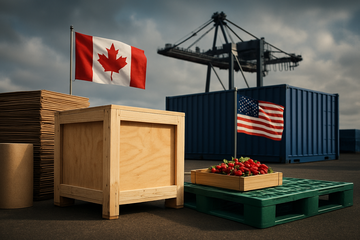
Nine Lines Reopen, the 50% Wall Stays: Trump's Canada Rollback Is Priced by One Senate Race
On October 23 the White House carved nine categories of Canadian goods — plywood sheets, corrugated paper, packing crates and boxes, refrigeration equipment, machinery, plastic bags, seaweed and algae — out of the 50% Section 338 tariff while adding certain valves, carpets and waste products to the list, effective October 30. No rate moved: the 50% statutory ceiling under 19 U.S.C. 1338, the Section 232 metals and lumber duties, and Canada's C$27.6 billion counter-tariff list all stay in force, so autos, dairy, alcohol and aluminum remain shut. The exclusions map precisely onto the inputs Maine's blueberry, potato and apple growers need from Canada, and Sen. Susan Collins' race against Troy Jackson — tied 49-49 in a poll taken Oct. 16-20 — is the clearest reason the list moved when it did. The investable consequence is asymmetry, not détente: US buyers of Canadian crates, machinery and refrigeration get relief, Canadian retaliation keeps squeezing US exporters, and non-US suppliers of beer, wine and farm equipment take share in a market where US brands are being delisted.

Ukraine's Starlink Speed Cap Produced a Signature, Not a Contract — and the Sovereign Communications Spend Lands on Satellites, Ground Segment and Terminals
Ukraine's Ministry of Defence signed a letter of intent with ICEYE and Nokia on October 22, 2026 to explore a sovereign satellite communications capability, with a first Ukrainian satellite targeted for 2028 — but the document implies no ordering, discloses no price and commits no financing, making it a category-defining signal rather than a revenue event. The trigger was SpaceX's 160 km/h cap on military-grade Starlink in force since October 13 and still binding on October 23, an instruction Reuters traced to inside the White House, while Reuters reported the same day that no viable short-term alternative to Starlink exists for Ukraine. What changes is the addressable order book: governments that cannot tolerate a political kill switch now buy satellites, ground segment and terminals outright, and that money flows to the equipment and platform layer — Nokia's secure networking and terminals, ICEYE's spacecraft, IHI's industrial base — rather than to consumer capacity resellers. The honest conclusion is that this is a 2027–2029 buildout option for platform and ground-system vendors, and a non-event for anyone modelling Ukraine's connectivity bill in 2026.
2026-10-23

Blackstone Raised a Record $63.3 Billion and Sold Almost Nothing: AI Infrastructure Is Now a Fee Engine, Not an Equity Trade
Blackstone split its third quarter in two: record inflows of $63.3 billion and fee-related earnings up 6% to $1.572 billion on record assets of $1.368 trillion, against net realizations down 34% to $331.5 million and distributable earnings down 13% per share. Management says AI infrastructure is about 7% of assets — roughly $96 billion — and the highest-return area of the firm, financed through Google-backed Crux AI, a $9 billion junior tranche inside an $18 billion Anthropic package, and a data center portfolio heading to about 6 gigawatts. The mechanism is capital migration: with Meta running negative free cash flow and NVIDIA organizing more than $500 billion of third-party compute financing, the marginal AI capital expenditure dollar now clears through private credit and contracted leases rather than public equity. The market paid for the fee engine — the shares rose 6.2% on Oct. 22 — but they are still down nearly 30% in 2026, and the wealth channel that funds the buildout is rationed.

Baidu Reached Kazakhstan First — Pony.ai's Astana MOU Buys a Regulatory Template, Not Robotaxi Revenue
The Oct. 23, 2026 memorandum of understanding between Pony.ai, inDrive and NVIDIA makes Kazakhstan the first Central Asian testbed for a Chinese Level 4 stack, but the announcement discloses no vehicle count, no contract value and no launch date — and Baidu's Apollo Go got to Kazakhstan about five weeks earlier with a local partner. The value of Astana is not rides in a 1.7 million-person capital; it is a legal precedent for remote-operator-supervised driverless operation that inDrive can reuse across 1,200 cities in 47 countries, and a certification ground for NVIDIA's Hyperion safety stack. For investors, the tradeable markers are narrow: a Kazakh government agreement, the Nov. 18, 2026 third-quarter print, and whether the same Gen-7 hardware can pass a Western road test in London.

The Dirty Secret of Vietnam's Coal Boom: 25-Year Fuel Contracts Written Against a Narrowing Tariff Moat
Vietnam is importing 17-19 million tonnes of coal in 2026 and has begun locking fuel supply to state-owned plants through 2047, because coal now supplies 54.5% of its electricity and gas, hydro and the grid cannot close the gap on the same timetable. The hidden fault line is price elasticity: the same Iran-driven spike that made coal strategically necessary pushed Newcastle to $150 a tonne, and Vietnam's seaborne buying shrinks as prices rise. The listed consequences are narrow — Mitsubishi Corp and Doosan Enerbility bank contracted fuel and EPC revenue, Core Natural Resources is converting the demand into profit while Peabody Energy ships its first cargo from a cost curve it cannot yet cover, and the relocation premium behind the load is deflating, which is the bullish case for Jasan Holding.
2026-10-22
Anthropic's $80.7 Billion Loss and Amazon's $53.4 Billion Gain Are the Same Trade: the S-1's Real Number Is $518 Billion of Fixed Commitments
Anthropic's draft IPO prospectus, as reviewed by the Wall Street Journal and Reuters, shows a company that turned $1.1 billion of first-half 2025 revenue into $16.3 billion in the first half of 2026 while booking an $80.7 billion net loss — and, more usefully, a revenue book in which two unnamed customers produced about a fifth of sales while $518 billion of compute commitments, roughly 80% of it payable regardless of usage, run for seven to ten years. The cost side is locked and the revenue side renews, so the $2 trillion marketing price and the $1.5 trillion price investors now discuss are a renewal schedule rather than a growth debate. The same private marks drive Amazon's $53.4 billion quarterly gain and Alphabet's $98.0 billion of other income, and the debt stack financing the buildout — CoreWeave carries $51.6 billion of it — is where a single counterparty decision would surface first.
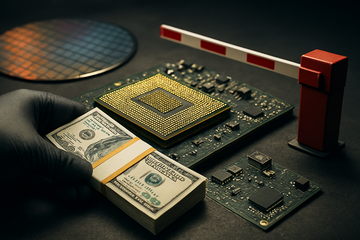
DeepSeek's $15 Billion Round Is the Toll Booth: One Domestic Chip Order Is Worth $5.6 Billion While NVIDIA Stays Shut Out
DeepSeek's roughly ¥100 billion ($14.98 billion) round — reported on Oct 21-22, 2026, one day after Washington published an order removing DeepSeek from federal civilian procurement and IT systems — was not a confidence event. The money came from inside the restricted perimeter: Tencent, CATL, GigaDevice, Midea, Meituan, Geely and a state AI fund, wired into the founder's partnership with no voting rights, so the check is procurement financing for compute that cannot be bought abroad. At least 160,000 Huawei Ascend 950DT accelerators for a gigawatt-scale Inner Mongolia campus come to roughly ¥40 billion ($5.6 billion) at list prices that rose 20-50% in two months, while NVIDIA's realized H200 sales to China stayed under 1% of data center revenue. For US equity investors this is a supply-chain signal, not a China-tech headline: the redirected capex is landing on Chinese silicon, memory and power, and NVIDIA's own filing says the foreclosure helped competitors build ecosystems that challenge it worldwide.

Meta's New Terms Make Publisher Content Free by Contract — and Publishers and Advertisers Just United to Object
From October 30, Meta's rewritten commercial terms let it crawl any website tied to a business account, with no opt-out and no contractual promise to honour robots.txt. On October 22 the Movement for an Open Web — a group whose members include digital advertisers and publishers — asked the European Commission and the UK's Competition and Markets Authority to suspend the change, and publisher groups filed in Brussels, Berlin and London in parallel. The alignment is the real signal: one clause sweeps up both the content a publisher sells and the product data an advertiser keeps, and Meta is offering both constituencies the same trade — a licence for free in exchange for a relationship they cannot walk away from. Because the CMA cannot use its Digital Markets Act powers against Meta before Friday, investors should price the licensing reset rather than the fine.
Nexans calls cable capacity the AI data-centre bottleneck—meaning the copper price trade is now an electrical-equipment order-book story
Nexans’ CFO says AI data-centre builds are increasingly gated by cable manufacturing capacity, not by upstream demand or even grid constraints. The key timing detail is long-lead XLPE (“CV”) production—about three years—which shifts investor attention toward how electrical-equipment and grid operators place and sequence orders, and how copper-linked material costs flow into those commitments.

The $389 Million Power-Chip Award Is 77% of Everything Washington Has Actually Spent on Chip R&D
On October 22, 2026, the Commerce Department's CHIPS R&D Office signed four letters of intent worth up to $389 million for power semiconductors and critical materials — the first federal R&D money pointed at the grid-facing end of the AI buildout instead of at accelerators. Against the $506.8 million Commerce had actually spent on the whole advanced-microelectronics R&D program, this single round equals about 77% of delivery to date. Two-thirds of it ($260 million) goes to fusion companies that have nothing to do with data centers, only $73 million targets vertical gallium nitride for a 2.5-megawatt AI rack, and the metal behind that transistor — gallium — is still roughly 99% Chinese. The investable read-through sits with the vendors already selling power into AI racks (onsemi, Vertiv, Eaton), the specialty foundry being paid to build the tooling (GlobalFoundries), and the substrate and materials layer with real pricing power (Coherent, Shin-Etsu Chemical, Sumitomo Metal Mining).
What to expect
Evidence-first notes with a visible point of view.
This section collects sharp takes on earnings, shareholder meetings, and market structure. Each new piece should make the thesis, the facts, and the implications obvious within the first few screens.
Expect direct analysis, not generic commentary.
Expect the data to be explicit and the argument to be easy to follow.