Latest
The day's market news, with the argument attached
New notes every trading day on earnings, policy and market structure. Each one opens with the conclusion, then the evidence, then the companies it hits.
2026-11-04


Crude’s $104→$88 war-premium unwind is already feeding a “cuts, not crisis” macro read
On Nov. 3, crude slid ~7.7% to about $88.69 while gold rose ~3% to roughly $4,068—an unusual pairing that points to de-escalation pricing, not broad risk-off. If that pricing holds into year-end, it tightens the pathway from “oil inflation risk” to December Fed odds and reframes refinery economics around cracks that haven’t fully broken to the downside yet.

Texas Flipped, but the AI Buildout's Clock Was Already Set: 474 Gigawatts and a Frozen Permit File
Democrats took both chambers and, in Texas, the governor's office and a US Senate seat, and the AI infrastructure complex sold off overnight: Nasdaq-100 futures fell 0.8%, Oracle lost 4% and CoreWeave 7%, and in Seoul SK hynix closed down 5.03%. The binding constraint on Texas data centers was never Washington's to lift — state permits have been frozen since Sept 21, 2026, and ERCOT's own interconnection calendar (Batch 1 applications in summer 2027, the final batch transmission plan in fall 2027) means no election outcome delivers meaningful Texas data center load before 2028. What the new statehouse changes is price, not volume: the cost of a megawatt is being shifted from Texas ratepayers onto the AI developer in Austin and in Washington at the same time. That is a multiple story for the AI complex and a re-timing story for the utilities holding Texas load.
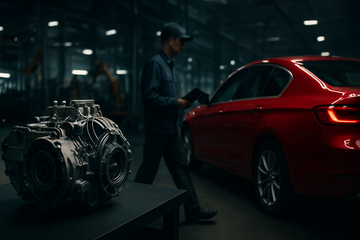
Schaeffler's 3,460 Cuts Price the Auto Downturn One Layer Below the OEM — BMW's Near-Zero Margin Guidance Confirms It
Schaeffler said on Nov 3, 2026 it will cut 3,460 jobs across Europe and close five plants by 2028 to remove about €300M of annual cost, and the next morning BMW guided its 2026 automotive margin to between -0.5% and +0.5%. Read together, the two releases show the downturn has moved out of OEM pricing and into tier-one capacity and labor: a supplier cannot fund overcapacity when its Chinese EV division loses money, and an OEM earning almost nothing cannot fund the discounts that keep its own plants full. For US-listed suppliers the read-through is not a forecast but a report card — Aptiv booked $48M of restructuring charges in nine months, Adient posted a quarterly net loss, and Lear and BorgWarner show what the exit looks like from the other side of the ledger.

Job Openings Jumped 333,000 in September: the AI-Layoff Thesis Has No Macro Leg, and December's Hike Gained One
September job openings rose to 7.52 million — the strongest September gain in the three-year window — with the quits rate at 2.1% and layoffs down to 1.0% of employment, a demand picture that directly contradicts the AI-labor-substitution case built on collapsing hiring. But the same data stops short of an inflation alarm: September payrolls added just 29,000 jobs and wage growth cooled to 3.0%, so the December hike, priced near 73–80% odds, rests on price momentum rather than on this print. The investable consequence is a barbell — own the vendors that monetize hiring (Robert Half, ADP) and the build-out that creates it (Quanta Services), and treat labor-scarcity margin squeeze in consumer services (Chipotle, HCA Healthcare) as the cost of a tighter labor market.

Shopify's 8.7% Drop Was About Mix, Not Agents: Blended Take Rate Rose While Gross Margin Fell 130 Basis Points
Shopify's Q3 2026 print missed on GMV and on the subscription line investors watch most closely, and the shares fell 8.7% on Nov 4 — yet the arithmetic does not support the theory that AI agents and payment networks are already siphoning Shopify's take rate. Blended revenue-to-GMV rose to 3.14% from 3.09%, and the only agent that ever tried to price the checkout, OpenAI's 4% ChatGPT fee, was withdrawn in March 2026. What actually broke was mix: subscription gross profit grew 17% while merchant solutions gross profit grew 35%, cutting gross margin 130 basis points to 47.6% and pointing to a Q4 gross margin of roughly 44% to 46%. At about 65 times forward earnings, the question is no longer whether agents steal the toll but who holds the wallet when checkout moves into AI surfaces — and Shopify is betting the company on Shop Pay.
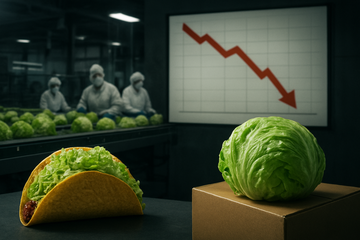
Taco Bell's Parasite Crash Cost $172 Million in Sales and Yum! Brands Only $10 Million — the Franchisee Paid the Rest
The 2026 cyclospora outbreak traced to a single iceberg lettuce processor in central Mexico took Taco Bell's U.S. same-store sales down 4 points in the third quarter of 2026, straight off a 7% gain in the prior quarter. The equity damage was trivial and the franchisee damage was not: Yum! Brands collects roughly 5.7 cents of every dollar of Taco Bell system sales, so an estimated $162 million of lost restaurant revenue — and most of the store-level profit — landed on the operators who actually own the restaurants, who also funded the discounts, the write-offs and the lawsuits. The next cycle is already scheduled: Taylor Farms will pull Mexican iceberg out of the U.S. market during the May-to-August window starting in 2027, while the federal traceability rule that would have forced this chain to document itself is barred from enforcement until July 2028.
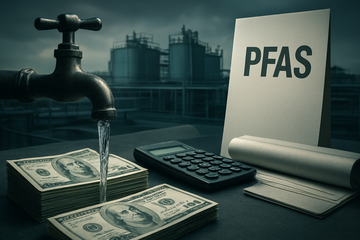
3M’s $7.35B PFAS settlement is creating a new pricing floor—starting with the municipal-water bills utilities can now capitalize on
3M’s $7.35B PFAS personal-injury resolution (timed across 2026–2034) doesn’t just cap chemical-maker liability—it also sets the first nationwide “unit” market reference point for how future PFAS costs get booked and financed by the municipal-water complex. New Jersey’s separately approved $2.5B PFAS settlements show the other half of the pipeline: long-duration, annual payments that translate contamination risk into predictable, credit-relevant cash flows for utilities and their suppliers.

CME Never Became Versant: The Nov. 3 Print Puts Pricing Power in Data, Not Volume
CME Group did not rebrand. Its third-quarter results were released on Oct. 21 under its own name, and the Nov. 3 print that has been mistaken for it belongs to Versant Media Group, the cable and news networks Comcast spun off on Jan. 5, 2026. Read together, the two prints describe the same mechanism: volume-linked tolls are cyclical cash machines — clearing and transaction fees still supply 79% of CME's revenue, and 16% more contracts converted into only 13% more revenue because the rate per contract fell — while everything sold as data or subscription compounded, from CME's record $243.1 million market data line (+20%) to ICE's record $336 million of fixed income data and analytics, Nasdaq's $3.365 billion recurring revenue base, and Versant's $245 million platforms line (+9.6%). Positioning follows the attach rate, not the volatility premium: the near-term test is a January print season in which Versant Media Group must clear an implied fourth-quarter revenue bar of $1.275 billion to $1.525 billion against $1.610 billion a year earlier.

Wayfair grew orders 12% with baskets 2% smaller: the big-ticket consumer is splitting, not deferring
Wayfair's September quarter, reported Nov 4, 2026, is the cleanest proof yet that the furniture slowdown is a share problem rather than a demand problem: U.S. revenue rose 11.4%, orders delivered jumped 12.2% to 11.0 million, and the company swung to $62 million of GAAP net income from a $99 million loss a year earlier. The catch is that average order value fell about 2% and gross margin slipped to 29.6% from 30.0%, so the buyer is transacting more often and spending less per trip while the store channel stays pinned near $10.6 billion a month and home resales run at their slowest pace of 2026. With retail diesel at $6.29 a gallon and the EIA forecasting Brent at $105 a barrel in the fourth quarter, the delivery costs that diluted margin should ease in 2027, which makes the gross margin line, not the revenue line, the thing to watch through the holidays.
2026-11-03

World Models Now Have a Price Range, Not a Price: $62.5 Million for Human Behavior, $1.03 Billion for Physics
42AI left stealth on November 2, 2026 with $62.5 million for a 'behavioral world model' that forecasts how individual traders will act, now running at ten brokerages. The money came from the founders and chairman Amir Gal-Or's Infinity Group over three years, not from venture investors, so the headline is an insider-set floor rather than the market's price for behavioral simulation — which is why the same class carries $2 billion at Simile and $1.03 billion at AMI Labs. Underneath the marketing, the company's own paper shows near-parity with frontier models on the imbalance-robust metric, so the moat is licensed data and regulated distribution, not compute. The investable read-through therefore runs to physical-AI and simulation budgets (NVIDIA, SK hynix, Bentley Systems) and to the listed risk-analytics and brokerage incumbents whose customers are now being modeled (Moody's, Nasdaq, Robinhood), not to the language-model trade.
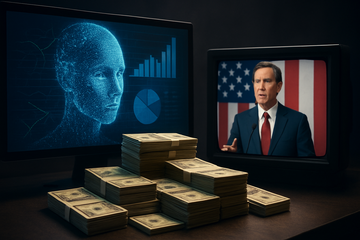
The $187 Million Slopaganda Flood Pays Broadcasters, Not Platforms — and the Bill Lands on Agencies
AI-generated political advertising did not slow down when the rules arrived; it sped up. The Wesleyan Media Project counted more than $187 million across at least 289 AI-generated or AI-assisted ads through Oct. 29, 2026 — up from $137 million and 220 ads two weeks earlier — with only 27% carrying an AI disclaimer and more than 90% of the money coming from one side of the aisle. Alphabet, Meta Platforms, Reddit and X answered by making disclosure an advertiser-side obligation, which pushes compliance cost onto campaigns and agencies while the money rotates into broadcast inventory that never needs an AI label. The consequence is a rotation, not a windfall: Fox Corporation booked a record $350 million midterm political haul and premium CTV CPMs reached $43, while the verification layer that certifies delivery is being pulled out of public markets by Nielsen's $13.60-per-share take-private of DoubleVerify.

Apple's Memory Squeeze Just Cut Its Margin Guide to 45-46%. The Fix Points at a Toll on Every AI Lab
On his first earnings call as chief executive, John Ternus guided Apple's December-quarter gross margin down to 45-46% from 47.9% and blamed memory costs plus Siri AI ramp expense, while CFO Kevan Parekh said AI opens \"opportunities across third-party apps and partnerships.\" Read together, the two remarks say the memory squeeze, not Siri, is the real story, and that Apple intends to refill a roughly $1.6 billion-a-quarter gross profit hole with services revenue collected from the labs whose apps sit on its own store. The catch: a 30%-era toll is the one instrument Apple's pending Supreme Court case and the EU's new 5% out-of-store commission make hardest to use, while ChatGPT and Meta's Muse are building storefronts designed to route around any such fee. Memory makers have already been paid; the toll remains an option Apple has not priced.

Brookfield's £20bn Selby AI Campus Contains No New Turbine: Britain's AI Bottleneck Is an Existing 4GW Connection
On 3 November 2026, Drax Group, Brookfield, the group's UK compute platform Radiant and Qai — the AI infrastructure company backed by the Qatar Investment Authority — announced a partnership to build more than 1GW of AI data centre capacity on the Drax power station estate in North Yorkshire, a programme that could exceed £20bn with £2.5bn for a 100MW first phase running from Q1 2028. Phase 1 draws electricity straight from the national grid through the site's existing 4GW connection, so it adds compute without adding a power plant. That is what makes the template interesting: it bypasses a queue where developers are seeking 72GW of connections against 45GW of national peak demand, and the 2026 Budget's Data Centre Covenant has turned legacy connections into policy-protected, transferable scarce assets. The read-through is not the obvious one — the electrical stack gets paid, the turbine order book does not — but the whole structure still rests on a tenant nobody has named.

Coca-Cola Europacific Partners Reaffirmed Guidance on a 1.5% Cost Target That Needs Roughly 2.4% in the Second Half
The third-quarter print looks like a clean growth story — revenue up 5.8% FX-neutral to €5.76bn, unit cases up 3.5%, revenue per unit case up 2.2% — and the full-year outlook was left untouched. The cost target buried in that outlook is the problem: first-half cost of sales per unit case rose 0.6%, so the 1.5% full-year guide implies second-half cost inflation near 2.4%, roughly what third-quarter pricing only just matched. Concentrate is incidence-linked to revenue, but aluminium and PET are not, and can makers are passing metal through in full — $405m of higher material cost at Crown Holdings in a single quarter — while the bottler has hedged more than 95% of FY26 commodities, protecting this year and exposing 2027. The result is a system where Coca-Cola raised 2026 guidance a week earlier at a 33.4% operating margin, and the 13.6%-margin bottler could only reaffirm: the pricing power is real, and it is not evenly distributed.

19 Midterms, 19 Wins: Election Day 2026 Tests the Record With a Hiking Fed, $104 Oil and Debt-Funded AI Capex
The S&P 500 has been higher 12 months after the October close in all 19 midterms since 1950, averaging 16.6%. That record survived four midterms where the Fed hiked into the vote, but not cheaply: October-to-December returned exactly 0.0% on average across 1978, 1982, 2018 and 2022, against +3.6% for all 19. Election Day 2026 arrives with a Fed that raised rates in September, held on 10-2 with two governors dissenting for another hike, Brent at $104.66, and AI capex that is now 32% debt-funded, so the marginal AI dollar is priced off the same policy rate being raised. The tradable question is not whether the index ends the year higher but who collects the cash: suppliers paid on volume (NVIDIA, TSMC, SK hynix) versus buyers funding a buildout on borrowed money (Alphabet), and producers versus fuel consumers (ExxonMobil, Delta Air Lines).

Fannie and Freddie Rally on Ackman's Exit Call — but the Rulebook Doesn't Exist and the Capital Gap Is $205 Billion
Bill Ackman's Oct. 22 call for a fast end to conservatorship, and the housing executive order President Trump signed the same day, lit up Fannie Mae and Freddie Mac — yet the Q3 2026 filings show both enterprises with negative common equity, a $238.0 billion senior preferred claim and regulatory capital shortfalls of $205 billion and $158 billion. The exit is gated by a capital rule that has never been written, at an agency that just cut its fraud investigator's budget 64%, and the order Trump signed pushes the GSEs to absorb private mortgage insurance and title risk that widens the very same gap. The tradeable gap therefore sits outside the GSEs, in the credit-scoring, mortgage insurance, title and origination chain that is already being repriced by rules that do exist.

Bankers Report Business Loan Demand Swung 28 Points Negative as AI Capex Pulls Credit to Nonbanks
On Nov. 2 the Fed's senior loan officers reported that business loan demand weakened for the first time in more than a year: the net share of banks seeing stronger C&I demand swung from +16.1% to -11.7% in one survey round, and banks blamed borrowers walking to more attractive bank or nonbank funding. The money did not disappear — it changed hands, because the same survey shows banks expanding lending to nondepository finance intermediaries and private equity funds while AI-adjacent commitments have grown from 9% to 13% of bank C&I commitments and now run near a quarter of tier-1 capital at large banks. With the Fed on hold at 3.75%–4.00% and markets pricing a 76% chance of a Dec. 8–9 hike, the squeeze on everyone who is not building AI data centers arrives just as the price of money goes up.

The Office Is Full and the Collaboration Is Gone: The New York Fed Survey That Undercuts the Office Recovery
A New York Fed survey of 1,835 college-educated workers, fielded in September 2026, found that 48.8% had no in-person meetings on their most recent day in the office and 70.6% had at least one teammate absent, which means attendance has been restored but the collaboration that offices are priced for has not. Because organizational sprawl, not absenteeism, explains about 48% of the lost face time, employers cannot repair it with mandates, and the landlord data already shows the strain: Hudson Pacific Properties lifted same-store leased occupancy 8.1 points year over year while average rent per square fell to $56.78 from $57.57, while SL Green Realty still shows a $128.3M trailing net loss against roughly 14x net debt to EBITDA. The pain sits upstream in real estate and office services, while commuting-linked demand holds up: Starbucks grew comparable coffeehouse sales 6.2% in Q4 FY2026 and Uber grew revenue 12.2% year over year in Q2 2026. For the December policy debate, the same bank's research argues that soft payrolls are compositional, so the committee should be reading inflation, not headcount.

Hong Kong Licensed 13 Crypto Venues and Just 2 Stablecoin Issuers: The Tokenization Push Is Really a Settlement Play
On Nov 2, 2026, Hong Kong's Financial Secretary Christopher Hui used the phrase \"similar risk, similar regulation\" to describe a bill heading to the Legislative Council before the end of the year, covering virtual-asset advisory, dealing, custody and management. The licence numbers tell you where the value sits: 13 virtual-asset trading platforms licensed against exactly two stablecoin issuers, HSBC and Anchorpoint Financial. Meanwhile Hong Kong Exchanges and Clearing is building the rails - tokenised deposits settling a HK$20 billion multi-currency digital green bond, an interbank tokenised gold project priced off the HAU reference, and a 2027 warehouse-receipt pilot - while DTCC put a rival tokenization service live on Oct 28, 2026 for US-domiciled assets. The honest caveat: Hong Kong's tokenized fund market was HK$10.7 billion as of March 2026, roughly 0.03% of the HK$42.2 trillion the city already manages, so the rails are being built ahead of the traffic.

Tinder DAUs Grew for the First Time in 3½ Years on $10 Million of AI Spend — Match Group's 14% EBITDA Jump Is Mostly a Base Effect
Match Group's third quarter looked like a margin story and was really an engagement story, and only one of the two is new. Revenue fell 2.5% to $891.2 million while adjusted EBITDA rose 14% to $344 million — but the GAAP line items show the profit came from a $55.8 million drop in general and administrative expense while research and development rose $14.8 million, the line where the roughly $10 million AI budget lands. The genuinely new information is engagement: Tinder's daily active users returned to year-over-year growth in September for the first time in three and a half years, and U.S. daily users grew in October. The unresolved information is monetization: 13.8 million payers, down 5%, at a company whose fourth-quarter guidance implies adjusted EBITDA falls 11%. Investors are being asked to pay a cash-flow multiple today for a user story management says converts in 2027.
What to expect
Evidence-first notes with a visible point of view.
This section collects sharp takes on earnings, shareholder meetings, and market structure. Each new piece should make the thesis, the facts, and the implications obvious within the first few screens.
Expect direct analysis, not generic commentary.
Expect the data to be explicit and the argument to be easy to follow.