Power & Grid
Load growth, and who gets to build for it
Interconnection queues, rate cases, turbines and transmission — what data-center demand is doing to utilities and the equipment makers behind them.
2026-10-24


90% Cheaper Tokens, One Legal Moat: OpenAI's Anti-Distillation Terms Are a Pricing Power Play
OpenAI's revised Usage Policies, effective November 20, 2026, forbid using its models or outputs to train competing models and require prior approval for any AI gateway or model router that resells access — while the company cut its entry-tier API price 90% in eight weeks, from $1.00 to $0.10 per million input tokens. Read as compliance hygiene this looks defensive; read as pricing it is offensive, because the token becomes a commodity while the right to train on it becomes scarce. Enforcement is no longer theoretical: Anthropic disclosed 16 million exchanges through roughly 24,000 fraudulent accounts, and OpenAI's own September campaign account points at Moonshot AI. The read-through for listed names runs upstream and into distribution: NVIDIA grew data center revenue 117% to $89.0 billion in the quarter ended July 26, 2026, and Microsoft, which hosts OpenAI's stateless APIs exclusively, ran FY2026 capital expenditure of $115.9 billion.
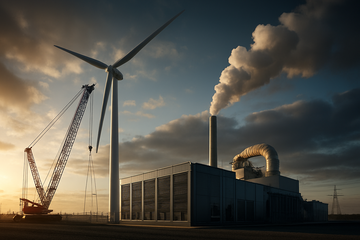
TikTok USDS Wants 4 Gigawatts by 2030 — and the Turbines to Serve It Start Shipping in 2029
TikTok's US entity has approached the market for several gigawatts of computing capacity, with one source putting the target at about 4 GW by the early 2030s — roughly the size of one Korean turbine supplier's entire US backlog. The bill, however, lands on Oracle: the joint venture must retrain its recommendation algorithm on US data inside Oracle's cloud, Oracle is a 15% shareholder, and Oracle is adding 850 MW of data-center capacity a quarter. With US data-center electricity projected at 325–580 TWh by 2028 and a White House pledge that makes buyers pay for their own generation and grid upgrades, this is a turbine-slot and 20-year power-contract trade, not a TikTok trade.
2026-10-23
2026-10-22
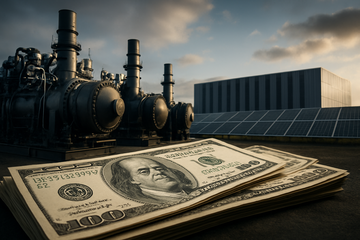
Trump's Data Center Power Mandate Has No Legal Teeth — the Money Still Flows to Turbines
President Trump's Oct. 21 directive that new large data centers must make their own electricity and pay host communities a “dividend” arrived with no executive order, no dollar figure and no enforcing agency — and a week earlier FERC had ruled that federal regulators cannot reach retail rate design for large loads. What actually binds is being written in state capitals, where Virginia's commission has already forced Dominion Energy to bill data centers directly for the transmission that serves them. The investable consequence is a capital shift out of utility rate base and into equipment order books such as GE Vernova, whose gas backlog reached 116 GW in the second quarter, while the ratepayer shield compresses returns on the utilities that built for data centers in the first place.
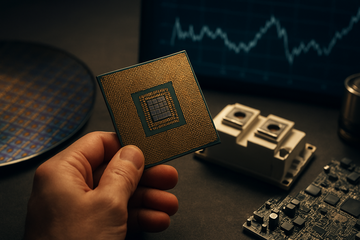
The $389 Million Power-Chip Award Is 77% of Everything Washington Has Actually Spent on Chip R&D
On October 22, 2026, the Commerce Department's CHIPS R&D Office signed four letters of intent worth up to $389 million for power semiconductors and critical materials — the first federal R&D money pointed at the grid-facing end of the AI buildout instead of at accelerators. Against the $506.8 million Commerce had actually spent on the whole advanced-microelectronics R&D program, this single round equals about 77% of delivery to date. Two-thirds of it ($260 million) goes to fusion companies that have nothing to do with data centers, only $73 million targets vertical gallium nitride for a 2.5-megawatt AI rack, and the metal behind that transistor — gallium — is still roughly 99% Chinese. The investable read-through sits with the vendors already selling power into AI racks (onsemi, Vertiv, Eaton), the specialty foundry being paid to build the tooling (GlobalFoundries), and the substrate and materials layer with real pricing power (Coherent, Shin-Etsu Chemical, Sumitomo Metal Mining).
2026-10-21
AEP Raised Guidance Into a 5.42% Long End: The AI Buildout Is a $78 Billion Rate-Base Bet, and the 30-Year Decides Who Pays
AEP raised 2026 operating EPS guidance to $6.25–$6.55 on July 30, 2026 — the clearest print yet tying the data-center buildout to regulated earnings, with 69 GW of contracted load behind a $78 billion capital plan and an ~11% rate-base CAGR through 2030. The catch is the funding stack: $45.5 billion of that plan is debt issued into a 30-year Treasury that closed at 5.42% on Oct. 20, 2026, while AEP's 3.05% dividend yield sits 237 basis points below that same bond. Because regulators, not customers, now decide who pays for the grid, the binding variable is the spread between the ~9.84% returns AEP is authorized to earn and the cost of the money that builds the assets — and the Oct. 28, 2026 call, where a new 2027–2031 capital plan is due, is the first test of it.
FERC Punted, Trump Pressed, Utilities Pushed: The AI Power Bill Now Has a Payer
Within 24 hours on Oct. 20, 2026, the Federal Energy Regulatory Commission said it was drafting rules to widen its authority over AI-driven load, President Trump told data center operators to pay host communities a 'dividend' and to make their own electricity, and the Edison Electric Institute published a study showing electric companies have already won ratepayer protection in more than 20 proceedings across 16 states. The answers differ in form but not direction: the data center pays for its own interconnection. That shifts grid construction off utility rate base and onto private balance sheets, which is why the beneficiaries are the contractors and equipment makers building the grid rather than the utilities whose rate cases have been stalled by the fight. It also means hyperscaler power costs become a company-level margin question instead of a political one.
AT&T Bought $23 Billion of Spectrum and Pledged Half Its Fiber to a Pension Fund: The AI Grid's New Financing Template
AT&T closed a $23 billion EchoStar spectrum purchase at the end of July 2026, lifting net debt from $126.4 billion to $149.8 billion in a single quarter and net leverage from 2.68x to 3.13x, and its own answer is to hand half of the fiber engine it just bought to a joint venture with Global Infrastructure Partners and CPP Investments. That is the template for financing the American AI grid: when the ten-year Treasury yields 5.11% and Brent sits near $109 a barrel, a telecom balance sheet cannot own both the spectrum and the fiber, so long-duration pension and infrastructure capital takes the asset while the carrier keeps the customer. For investors, the spread between contracted AI-grid cash flows and the long end — not headline AI capex — is what now sets the price of fiber, of contracted megawatts and of the vendors that build both.

Netflix's Cash Utility Rests on a $2.8 Billion Breakup Fee — and the Ad Engine Just Missed by $300 Million
Netflix beat on third-quarter earnings, then guided fourth-quarter revenue to $13.44 billion and earnings to $0.67 a share — both below consensus — and cut its 2026 advertising forecast to about $2.7 billion from about $3.0 billion. The defense that carried the stock through a 25% drawdown, that Netflix is a self-funding cash utility, does not survive the balance sheet: trailing free cash flow of $11.4 billion contains a $2.8 billion termination fee from the abandoned Warner Bros. Discovery deal, nine-month buybacks of $10.8 billion have outrun cash generation of $9.5 billion, and net debt has risen $4.8 billion in two quarters. With advertising now the only second monetisation cycle Netflix has, and Alphabet's Asia-Pacific ad base alone running at roughly $77 billion a year, the ad tier has to work — and it just missed by $300 million.
2026-10-20
2026-10-17
2026-10-16
Prologis's 5.8 GW Pipeline Confirms Industrial REITs Are Now Bidding in the AI-Grid Power Auction
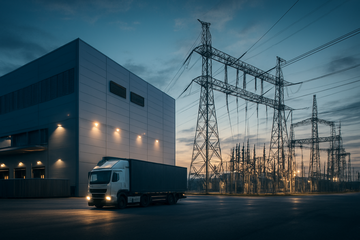
Prologis's Q3 FY2026 print — Core FFO $1.60, revenue $2.39B, 95.6% occupancy — discloses a 5.8 GW data-center pipeline (1.7 GW with secured power, 4.1 GW in advanced stages), with data-center supply-chain tenants now 10% of global new leasing and 17% in the US (vs ~5% a year ago). The raise in FY26 development-starts guidance to $5.0–$5.75B — partly data-center — alongside a $2.4B equity raise shows the company converting warehouse land, substation adjacency, and development muscle into an offer hyperscalers cannot easily replicate. The question for investors is no longer whether industrial REITs are participating in the AI-grid auction, but which listed names own the land, the power, and the balance-sheet capacity to keep winning it.
$1,255/Ton Hot-Rolled Coil Is a US Steel Pricing-Power Story, Not a Trade Story
Trump's 50% Section 232 tariff has collapsed finished steel imports 8.5% year-to-date through September 2026 per AISI, lifting hot-rolled coil to a four-year high — and handing Nucor, Steel Dynamics and Cleveland-Cliffs a structural pricing floor their Q2 results only partly reflected. The same mechanism is squeezing Ford and General Motors working capital into 2027, while Berkshire Hathaway's 52% August cut to Nucor is the smart-money counter-signal the bulls have yet to reconcile.
2026-10-14
2026-10-13

2026-10-12

2026-10-11

Levi's $78.6M Tariff Refund Lifted Q3 Margin 490bps — Apparel Earned It, Off-Price Burned It
Levi Strauss raised FY2026 EPS guidance to $1.54-$1.56 after $78.6M in IEEPA tariff refunds drove 490bps of Q3 gross-margin expansion and $0.16 of adjusted EPS. The structural split: apparel brands (LEVI, NKE, PVH) absorbed refunds as margin lift, while off-price retailers (BURL, TGT) routed them straight back into lower shelf prices — turning one-time cash into a wash on the P&L. Levi's choice to redeploy only $60M of the $80M into holiday marketing and supply-chain initiatives leaves roughly $20M of clean margin in the FY26 guide.
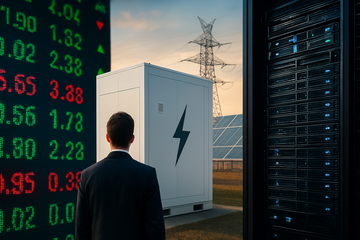
Xcel Just Made 'Rate Holiday' the AI-Power Business Model — And Every Hyperscaler-Linked Utility Has to Match
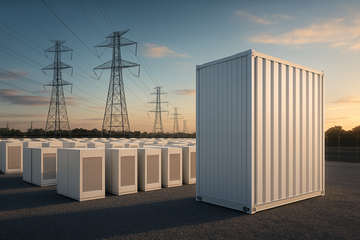
On Oct 9, Xcel Energy filed an 8-K saying its Minnesota utility will freeze customer base rates for 2027 and 2028, funding the lost increases by accelerating federal tax credits from five battery projects. The trick works only because Minnesota is leaning on Battery-ITC optics to absorb ~$1.5B of two-year revenue-requirement pressure while a 20+ GW data-center pipeline eats through capex. Re-priced in a single session: Constellation Energy, Vistra, and NextEra all have to answer how they would monetise hyperscaler load without a rate-payer freeze — and every state PUC now has a price list for AI-era grid finance.
2026-10-09

2026-10-07
What to expect
Evidence-first notes with a visible point of view.
This section collects sharp takes on earnings, shareholder meetings, and market structure. Each new piece should make the thesis, the facts, and the implications obvious within the first few screens.
Expect direct analysis, not generic commentary.
Expect the data to be explicit and the argument to be easy to follow.